
On This Page
Finding the right travel backpack can feel surprisingly complicated. One bag looks perfect online but turns out to be too bulky. Another has plenty of pockets but barely fits your laptop. And the biggest concern often comes when you reach the airport: will the airline accept it as a personal item?
A well-chosen personal item backpack can make flying simpler.
It keeps essentials close, fits beneath the seat in front of you when it meets airline requirements, and may help you travel without purchasing an additional baggage allowance.
But size isn’t the only factor worth considering.
A backpack should also be comfortable to carry, easy to organize, and suitable for the belongings you actually bring. Features such as laptop protection, zipper quality, shoulder straps, and water-resistant materials can make a noticeable difference.
In this guide, we’ll cover 11 practical buying tips, compare personal item backpacks with carry-on bags, explain common US airline size rules, and help you choose a travel backpack that suits your needs.
Whether you’re planning a weekend getaway, a short business trip, or your next flight, these tips will help you shop with more confidence.
What Is a Personal Item Backpack?
A personal item backpack is a backpack small enough to qualify as a personal item under an airline’s baggage rules.
A personal item normally travels in the cabin and is stored beneath the seat in front of you rather than in an overhead bin.
Examples of personal items can include small backpacks, laptop bags, purses, and compact travel bags.
The important distinction is that airlines classify bags according to their size and applicable baggage policies, not simply the product name.
A manufacturer might advertise a backpack as airline-friendly, but that doesn’t guarantee acceptance on every flight.
For example, a backpack that meets one airline’s published personal item dimensions may exceed another airline’s limit.
The best approach is to check your airline’s requirements before choosing a bag.
Is a Backpack a Personal Item?
Yes, a backpack can count as a personal item when it meets the airline’s size requirements and can be stored in the designated space.
However, a large hiking backpack or oversized travel pack may be classified as carry-on baggage instead.
That’s why checking actual dimensions matters more than relying on terms such as small travel backpack, flight-approved, or personal item bag.
Personal Item Backpack Size: US Airline Rules
One of the first things to check when shopping for a personal item backpack is the airline’s baggage policy.
Rules vary between airlines, and some distinguish between personal items and larger carry-on bags.
The following table summarizes published policies for several major US airlines.
| Airline | Personal Item Requirement | Important Detail |
|---|---|---|
| American Airlines | Maximum 18 × 14 × 8 inches | Must fit beneath the seat |
| Frontier Airlines | Maximum 18 × 14 × 8 inches | Handles, wheels, and straps count |
| Spirit Airlines | Maximum 18 × 14 × 8 inches | Must fit beneath the seat |
| Delta Air Lines | Small personal item that fits beneath the seat | No single numerical personal-item limit listed on its general carry-on page |
Last checked: November 2026.
Sources: American Airlines, Frontier Airlines, Spirit Airlines, and Delta Air Lines official baggage policies.
Airline policies can change. The information above is a planning reference, not a guarantee of acceptance.
Always check the operating airline’s current rules and your ticket conditions before traveling.
The available space beneath a particular seat may also vary with aircraft configuration.
What About Other Airlines?
If you’re traveling with another US or international carrier, review its official baggage page.
Don’t assume that a bag accepted by American Airlines or Frontier will qualify on every airline.
This matters especially when your itinerary includes multiple carriers.
A backpack that works on the first flight may not meet the rules of a connecting airline.
11 Smart Tips for Choosing a Personal Item Backpack
1. Check the Actual Backpack Dimensions
The most important buying tip is simple: measure the bag.
A personal item backpack should fit within the dimensions allowed by the airline you plan to use.
Look for three measurements:
- Height
- Width
- Depth
Don’t rely only on the advertised capacity in liters.
Two backpacks with the same capacity can have different shapes.
For example, one may be tall and narrow while another is shorter and deeper.
A short, deep backpack could exceed an airline’s depth limit even when its overall volume seems modest.
Also check whether the published dimensions include external pockets, handles, and other protruding parts.
For a soft-sided bag, measure it after packing because clothing and accessories can cause the fabric to expand.
Buying tip: Check the fully packed dimensions, not just the empty backpack’s measurements.
2. Choose the Right Capacity: 20L vs 25L vs 30L
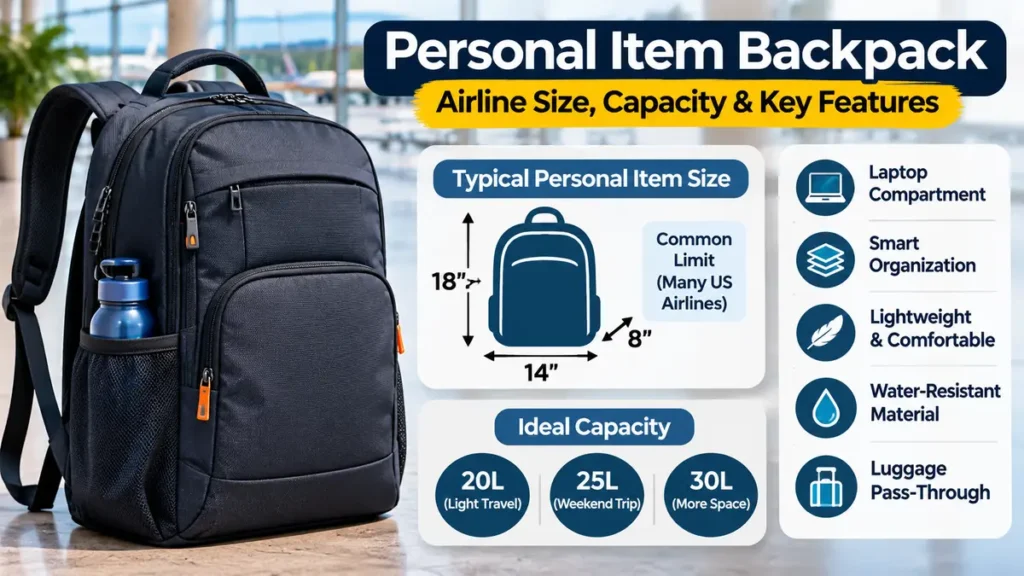
Check your backpack’s packed dimensions against your airline’s personal item limits before traveling.
Backpack capacity is usually measured in liters.
That number helps estimate how much a backpack can hold, but it doesn’t determine whether the bag qualifies as a personal item.
A compact 20-liter backpack may work well for daily essentials and a short trip.
A 25-liter model can offer additional room for clothing and electronics.
A 30-liter backpack may be useful for travelers who pack efficiently, although many bags at this capacity can be too large for certain personal-item restrictions.
Here’s a practical comparison.
| Capacity | Typical Use | What to Consider |
|---|---|---|
| 15–20L | Daily essentials and light travel | Limited clothing space |
| 20–25L | Weekend trips and laptop travel | Balance of storage and portability |
| 25–30L | Short trips with more clothing | Dimensions require careful checking |
| Above 30L | Larger travel loads | More likely to exceed some limits |
These are general capacity categories, not airline approval ranges.
For most shoppers, a compact bag with a useful interior layout is more practical than choosing the largest possible capacity.
3. Look for a Comfortable Carrying System
A backpack can meet airline size rules and still be uncomfortable to carry.
Think about how you’ll use it outside the aircraft.
You may need to walk through large airport terminals, use public transportation, or carry the bag while exploring a city.
Comfortable shoulder straps can make those activities easier.
Consider features such as:
- Adjustable shoulder straps
- Suitable padding
- A supportive back panel
- Comfortable weight distribution
- A convenient top or side handle
Some backpacks include a sternum strap that helps keep shoulder straps positioned while walking.
The usefulness of that feature depends on the bag’s design and your preferences.
Don’t assume that thicker padding always means better comfort.
A backpack with poorly shaped straps may still feel awkward.
If possible, evaluate how the backpack fits when loaded with the items you normally travel with.
4. Choose a Useful Laptop Compartment
If you travel with a laptop, a dedicated compartment can be valuable.
Many personal item backpacks include padded storage for a laptop or tablet.
However, manufacturers may advertise compatibility using screen sizes rather than the exact dimensions of the computer.
Two laptops with the same screen size can have different physical dimensions.
Measure your laptop before buying.
Check the compartment’s height, width, and thickness.
A protective sleeve with padding can help reduce everyday bumps, but it doesn’t guarantee protection from drops or impacts.
Some bags offer a separate laptop access zipper.
That can make retrieving a device easier during travel.
For a business trip, the ideal personal item backpack may provide convenient computer access without requiring you to unpack clothing and other belongings.
5. Consider a Clamshell Opening
Backpacks commonly have top-loading or clamshell-style openings.
A top-loading backpack opens from the upper section, making it suitable for simple everyday use.
A clamshell backpack opens more widely, sometimes like a suitcase.
This can make it easier to arrange folded clothing, packing cubes, and smaller accessories.
For short trips, a clamshell opening may be particularly convenient.
You can see more of the contents without digging through the bag.
However, some clamshell designs require additional floor or bed space to open fully.
Think about where you’ll be using the backpack.
If you frequently access your belongings while standing in an airport, convenient external pockets may matter more than a full clamshell opening.
Best approach: Choose an opening style that suits both packing and everyday access.
6. Keep Organization Simple
A good personal item backpack should make important belongings easy to find.
However, an excessive number of compartments isn’t always useful.
Consider how you plan to separate your belongings.
A practical layout might include a main compartment for clothing, a padded laptop section, and a smaller pocket for frequently used accessories.
A secure interior pocket can also help organize items such as keys or travel documents.
For travelers carrying several small electronic accessories, a removable organizer pouch may be more flexible than dozens of built-in pockets.
Avoid buying a backpack simply because it advertises a high pocket count.
Look at whether the compartments are large enough, easy to reach, and positioned logically.
The best personal item backpack is one that helps you find your belongings without creating unnecessary complexity.
7. Check the Material and Water Resistance
Travel backpacks are available in different materials, including polyester, nylon, and coated fabrics.
Each material has advantages and limitations.
Lightweight fabric can reduce the bag’s empty weight.
Tightly woven or coated materials may provide some resistance to rain and moisture.
However, water-resistant doesn’t necessarily mean waterproof.
Water may still enter through zippers, seams, or openings.
If you travel frequently in rainy conditions, consider how the entire bag is constructed rather than focusing only on the fabric label.
A rain cover or separate waterproof pouch may be useful for protecting certain belongings.
The appropriate solution depends on your activities and the weather conditions you expect.
8. Check Zippers, Stitching, and Build Quality
A backpack is only as useful as its construction allows.
Poor-quality zippers can become frustrating during a trip.
Weak stitching around handles or shoulder straps may reduce durability.
Before buying, examine the available product information.
Look for details about zipper construction, reinforcement around stress points, and warranty coverage.
If you’re shopping in person, open and close the compartments to see how smoothly they operate.
For online shopping, review manufacturer specifications and relevant owner feedback.
Be cautious about exaggerated claims such as indestructible or guaranteed for every trip.
No backpack is immune to wear.
Good construction and suitable use matter more than marketing language.
9. Consider a Luggage Pass-Through Strap
A luggage pass-through strap is a useful feature when carrying a backpack alongside a rolling suitcase.
It allows a compatible backpack to slide over the suitcase’s extended handle.
That can make moving through airports more convenient.
However, the feature matters most if you regularly travel with two bags.
If you’re aiming for personal-item-only travel, a luggage strap may be unnecessary.
Consider whether you’ll actually use it.
Also check how the strap fits your suitcase handle and whether the combined bags remain stable.
A personal item backpack should work with your travel style rather than include features you’ll rarely need.
10. Compare Personal Item Rules With Your Fare
Not all airline tickets include the same baggage allowances.
For some fares, a personal item may be included while a larger carry-on requires an additional purchase.
Other fares may include both.
The distinction can influence which backpack makes the most sense.
If you regularly book budget fares that include only a personal item, a compact backpack may be especially practical.
But choosing a bag solely to avoid baggage charges can lead to disappointment if it doesn’t hold the belongings you need.
Check your fare rules before buying.
For example, Frontier’s published baggage guidance distinguishes between included personal items and carry-on baggage that may require an additional purchase.
A bag that exceeds the personal-item allowance may result in an additional charge.
Important: Don’t rely on the fact that other passengers have carried similarly sized bags without a problem. Follow the published allowance for your own itinerary.
11. Choose the Backpack That Fits Your Travel Habits
The best personal item backpack isn’t necessarily the most expensive or the one with the largest capacity.
It’s the one that meets your practical needs.
Think about your usual trips.
Do you travel for one or two nights, or do you prefer longer vacations?
Do you bring a laptop?
Will you carry the backpack around the destination, or is it mainly for transporting belongings between home and your hotel?
A business traveler may prioritize laptop access and a simple appearance.
A weekend traveler may prefer a roomy main compartment.
Someone taking frequent short flights may value compact dimensions and predictable under-seat storage.
Instead of buying based on appearance alone, match the bag to the type of travel you actually do.
Personal Item Backpack vs Carry-On Backpack
These two categories are often confused.
A personal item backpack is intended to fit within the airline’s personal-item allowance, usually beneath the seat.
A carry-on backpack is generally designed for the larger cabin baggage allowance, which may involve overhead-bin storage.
| Feature | Personal Item Backpack | Carry-On Backpack |
|---|---|---|
| Typical storage location | Under the seat | Overhead bin or permitted cabin storage |
| Size | Usually smaller | Typically larger |
| Capacity | Often more limited | Usually greater |
| Airline allowance | Depends on policy and fare | Depends on policy and fare |
| Good for | Essentials and light packing | More clothing and travel gear |
| Key consideration | Personal-item dimensions | Carry-on dimensions and fare |
A larger carry-on backpack isn’t necessarily a better purchase.
If you mainly take short trips, the added capacity may be unnecessary.
On the other hand, a compact personal item may not provide sufficient space for a week-long trip with substantial clothing requirements.
Choose according to your itinerary.
Can a Personal Item Backpack Fit Under an Airplane Seat?
A properly sized personal item backpack is intended to fit beneath the seat in front of you.
However, the available under-seat space varies by aircraft and seating configuration.
A backpack that fits within an airline’s published maximum dimensions is more likely to be suitable, but its shape and how it is packed also matter.
A soft-sided backpack may fit into spaces where a rigid bag would be awkward.
That doesn’t mean you should force an oversized bag into the available space.
A bag should not block required clearance or interfere with cabin safety instructions.
The airline crew’s directions take priority.
How to Measure a Packed Backpack
Place the backpack on a flat surface after packing it normally.
Measure its maximum height, width, and depth.
Include bulging exterior pockets and any components covered by your airline’s measurement rules.
Compare those measurements with the published limit.
If your backpack has an expansion zipper, make sure it remains within the permitted dimensions when expanded.
This quick check is much more reliable than estimating size from product photographs.
Personal Item Backpack for Weekend Travel
For a short weekend trip, you may not need a full-size suitcase.
A compact backpack can sometimes hold clothing, toiletries, and essential electronics.
The amount you can carry depends on the bag’s dimensions, your clothing, and your personal packing habits.
A simple weekend setup might include a change of clothes, sleepwear, toiletries, charging accessories, and a few personal essentials.
Packing cubes may help separate clothing from electronics.
However, don’t pack the bag so tightly that exterior pockets expand beyond the airline’s size allowance.
If your trip requires substantial footwear, bulky winter clothing, or special equipment, a larger baggage option may be more practical.
Traveling light is useful only when your belongings still fit comfortably.
Personal Item Backpack for Business Travel
Business travelers often need different features from vacation travelers.
Laptop storage may be the priority.
A dedicated compartment can help keep the computer separate from clothing and other accessories.
External access to a notebook, charging cable, or travel documents can also be convenient.
Choose a bag that opens easily without spilling its contents.
If you carry formal clothing, consider whether the bag can accommodate it without excessive folding or compression.
For a business trip involving several meetings, a separate carry-on may be more suitable if your clothing and equipment exceed a personal item’s practical capacity.
The ideal personal item backpack should support your routine without forcing you into an uncomfortable packing arrangement.
Personal Item Backpack vs Under Seat Luggage
Backpacks aren’t the only option for under-seat storage.
Certain compact rolling bags and soft travel totes are also designed for personal-item use.
A backpack spreads weight across the shoulders and leaves both hands available.
A small rolling bag may be more convenient for travelers who prefer not to carry weight on their backs.
However, wheels and handles occupy space and may count toward the airline’s size limits.
Rolling bags can also be less convenient on stairs or uneven surfaces.
| Consideration | Backpack | Rolling Under-Seat Bag |
|---|---|---|
| Carrying method | Shoulder straps | Wheels and handle |
| Hands-free use | Usually easier | Less convenient while rolling |
| Stairs | Often easier | May need lifting |
| Storage efficiency | Depends on design | Wheels and frame take space |
| Best for | Walking and mixed travel | Smooth airport surfaces |
Neither format guarantees personal-item compliance.
Always verify the dimensions of the exact bag.
Common Personal Item Backpack Buying Mistakes
Assuming Every 30L Backpack Qualifies
Capacity alone doesn’t determine airline approval.
Check dimensions.
Forgetting About the Packed Size
An overstuffed backpack can become too deep for the published limit.
Choosing Too Many Compartments
Extra pockets can add complexity without improving organization.
Ignoring Shoulder Strap Comfort
A bag that’s uncomfortable in the airport may be frustrating throughout the journey.
Buying Without Measuring Your Laptop
Laptop compartment claims may not match the physical size of your device.
Confusing Carry-On and Personal Item Allowances
The rules and included allowances may differ.
Trusting Universal Airline Approval Claims
No manufacturer’s marketing phrase overrides an airline’s baggage policy.
Ignoring the Return Policy
Before ordering, confirm whether the seller accepts returns if the backpack doesn’t fit your equipment or travel needs.
Personal Item Backpack Buying Checklist
Before purchasing a personal item backpack, confirm the following:
- The backpack’s dimensions meet the rules of your intended airline.
- Its packed size remains within the applicable allowance.
- The capacity is appropriate for your usual trips.
- The shoulder straps and back panel suit your carrying needs.
- Your laptop fits the intended compartment.
- The main compartment is easy to access.
- The zippers and stitching appear suitable for regular travel.
- The material suits your expected conditions.
- The bag’s empty weight is reasonable.
- You can access essential items conveniently.
- The warranty and return policy are clear.
Use this checklist to compare options rather than relying only on star ratings or marketing descriptions.
Frequently Asked Questions
What is a personal item backpack?
A personal item backpack is a backpack that meets an airline’s personal-item requirements and can be stored in the designated cabin space, usually beneath the seat in front of you.
Is a backpack considered a personal item?
Yes, a backpack can qualify as a personal item when it meets the airline’s size and baggage rules. Larger backpacks may instead count as carry-on baggage.
What size backpack is allowed as a personal item?
It depends on the airline. American Airlines, Frontier, and Spirit publish a limit of 18 × 14 × 8 inches, while other carriers may have different requirements.
Is a 25L backpack a personal item?
Possibly. A 25-liter capacity doesn’t guarantee compliance. Check the backpack’s packed height, width, and depth against your airline’s limits.
Can a 30L backpack be a personal item?
Some compact designs might meet certain airlines’ requirements, but many 30-liter backpacks are too large. Check the actual dimensions rather than relying on capacity.
Does a personal item backpack go under the seat?
Generally, yes. Airlines commonly require personal items to fit beneath the seat in front of the passenger, subject to aircraft and safety requirements.
What’s the difference between a carry-on backpack and a personal item backpack?
A personal item backpack is generally smaller and intended for under-seat storage. A carry-on backpack is usually larger and may be stored in an overhead bin.
Can I take a personal item backpack and a carry-on suitcase?
Many airline fares permit both, but allowances vary. Check your ticket’s baggage terms and the operating airline’s rules.
What should I look for in the best personal item backpack?
Prioritize compliant dimensions, comfortable straps, practical organization, useful laptop storage if needed, suitable materials, and reliable construction.
Do personal item backpacks need to be soft-sided?
Not universally, but soft-sided bags can provide some packing flexibility. They must still meet the airline’s size and storage requirements.
Is a personal item backpack good for international travel?
It can be, but international itineraries may involve airlines with different personal-item policies. Check every operating carrier before traveling.
How do I avoid unexpected baggage fees?
Review your airline’s official allowances, measure your packed bag, confirm what’s included in your fare, and avoid relying on unverified airline-approval claims.
Final Thoughts
Choosing a personal item backpack starts with understanding the rules of the airlines you use most often.
Once you’ve confirmed the permitted dimensions, focus on comfort, organization, and the features that genuinely support your travel needs.
For a short trip, a compact backpack with a practical interior may be enough.
If you regularly travel with a laptop, a well-designed computer compartment could matter more than extra clothing capacity.
And if you’re considering a larger travel bag, remember that more liters don’t automatically mean a better fit beneath an airplane seat.
Measure carefully, compare the actual features, and choose a personal item backpack that makes your journey easier without creating problems at the boarding gate.
References and Further Reading
- American Airlines: Carry-On Baggage
- Frontier Airlines: Bag Options
- Spirit Airlines: Contract of Carriage
- Delta Air Lines: Carry-On Baggage
- Pack Hacker: Personal Item Bags
- Travel + Leisure: Personal Item Bags
Editorial note: This article provides general purchasing guidance based on publicly available information and airline baggage policies. It does not claim personal testing of individual backpack models. Verify current airline restrictions before flying.