On This Page
Packing for a trip can be frustrating, especially when you’re trying to travel light but still need room for clothing, shoes, and everyday essentials. A traditional suitcase may feel excessive for a weekend getaway, while an ordinary backpack might not hold everything comfortably.
That’s where a foldable duffle bag comes in.
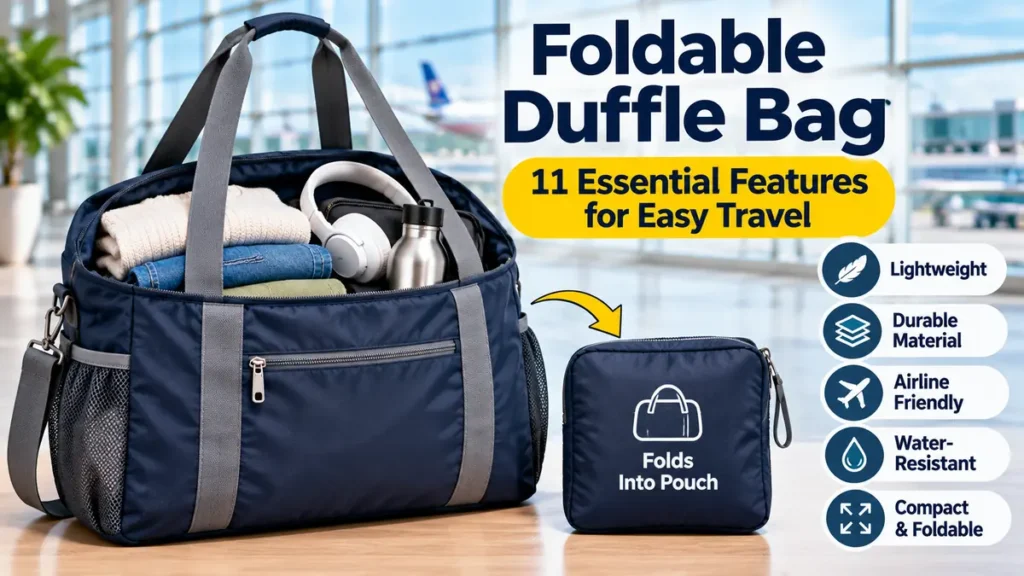
Unlike bulky luggage that takes up space even when empty, a foldable duffle can be packed into a compact pouch or folded into itself when you’re not using it. Open it when you need additional storage, then fold it away after your trip.
For many travelers, that’s a useful combination.
But foldable bags aren’t all built the same. Some are lightweight and designed for occasional use. Others feature reinforced handles, shoulder straps, multiple compartments, and weather-resistant fabrics.
Choosing the wrong one can leave you with an uncomfortable bag, unreliable zippers, or a shape that doesn’t fit your travel needs.
This guide explains 11 essential features to consider when choosing a foldable duffle bag, along with capacity comparisons, airline baggage considerations, practical uses, and common mistakes to avoid.
Whether you’re planning a short vacation, a gym session, a road trip, or a longer journey, you’ll learn how to choose a bag that fits your routine.
What Is a Foldable Duffle Bag?
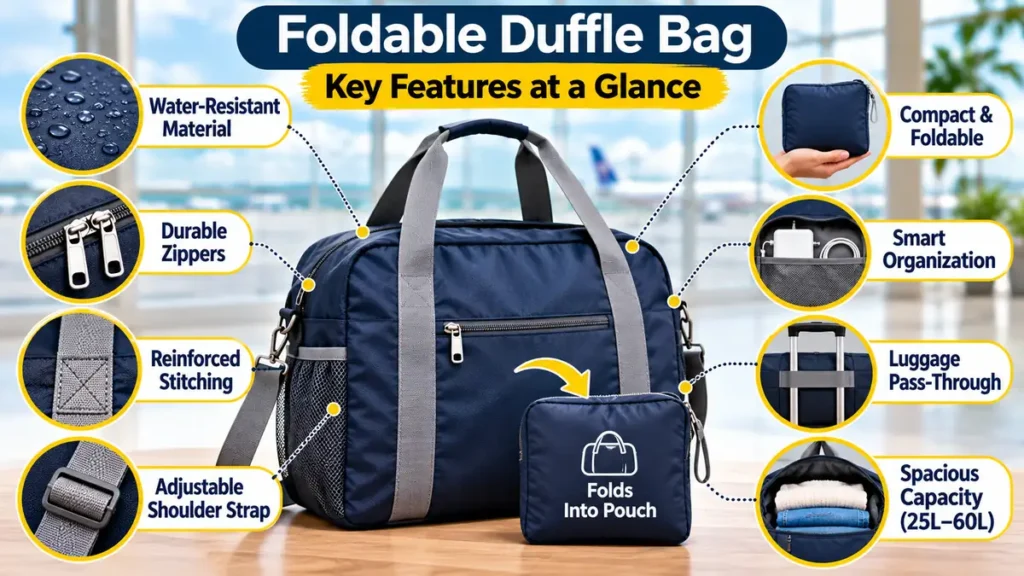
A foldable duffle bag is a soft-sided travel bag designed to fold or pack down into a smaller size when empty.
Most models have a roomy main compartment, carrying handles, and sometimes an adjustable shoulder strap.
Their distinguishing feature is compact storage.
Some fold into an attached pocket, while others come with a separate storage pouch. Certain designs use lightweight fabrics that allow the bag to collapse easily without requiring a rigid frame.
Once unfolded, the bag can hold clothing and other compatible travel belongings much like a conventional duffle.
The main advantage is that it doesn’t occupy as much storage space between trips.
However, foldable bags often sacrifice some structure and padding to achieve their compact design.
That’s why it’s important to consider more than just how small the bag becomes when folded.
Why Choose a Foldable Duffle Bag?
A foldable duffle bag can be useful when you want flexible storage without carrying a heavy suitcase.
It may work well as your main bag for a short trip or as an additional bag packed inside your luggage.
For example, you might bring a small folded duffle on vacation and use it for clothing or extra belongings during your return journey.
At home, a compact foldable bag is easier to store in a closet, drawer, or larger piece of luggage than many rigid travel bags.
Still, there are trade-offs.
Some foldable models have limited padding, minimal organization, and less comfortable carrying systems than dedicated travel backpacks.
A foldable duffle is most useful when its lightweight construction and compact storage solve a real problem for you.
11 Essential Features to Look for in a Foldable Duffle Bag
1. Compact Folded Size
The first feature to examine is how small the bag becomes when folded.
A product may be advertised as foldable without being particularly compact.
Some designs collapse into a relatively flat bundle. Others pack into a small attached pouch.
When comparing products, look for actual folded dimensions rather than descriptions such as ultra-compact or space-saving.
Consider where you’ll store the bag.
Will it fit inside a suitcase pocket? Can you keep it in a drawer at home? Does it take up too much space in your main backpack?
Also check how easy it is to unfold and repack.
A bag that requires careful folding every time may become inconvenient.
An integrated storage pocket can be helpful because the pouch stays attached to the bag and is less likely to get misplaced.
Travel tip: Compare both folded and unfolded dimensions before choosing a model.
2. Suitable Capacity for Your Trips
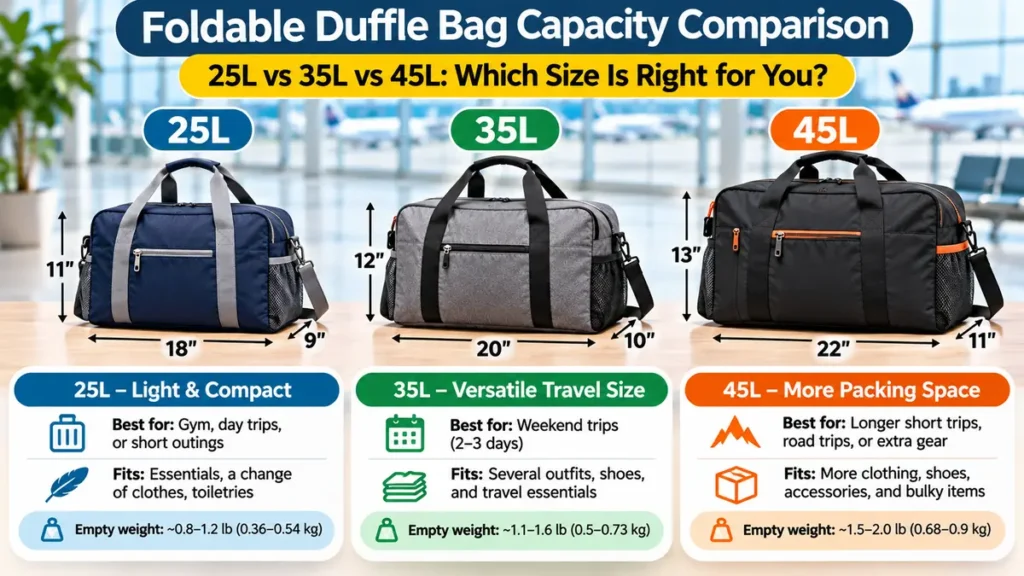
Duffle bag capacity is commonly measured in liters.
The right capacity depends on how much you typically pack and how you plan to use the bag.
A small foldable duffle bag may work for light travel, a gym session, or a few everyday essentials.
Larger models can accommodate additional clothing and equipment, but they may become awkward to carry when fully packed.
Here’s a general guide.
| Capacity | Possible Uses | Main Consideration |
|---|---|---|
| 15–25L | Gym essentials, light outings | Limited clothing space |
| 25–35L | Weekend travel, compact packing | Check airline dimensions |
| 35–45L | Longer short trips, extra clothing | Can become heavy to carry |
| 45–60L | Road trips, larger packing loads | May exceed cabin limits |
| Above 60L | Bulky storage and equipment | Weight and portability |
These ranges describe general packing capacity, not airline approval.
Two bags with the same liter rating may have very different shapes and dimensions.
For everyday travel, choose the smallest capacity that comfortably accommodates your belongings.
3. Lightweight but Durable Material
One reason travelers choose a foldable duffle bag is its relatively lightweight construction.
Common materials include nylon, polyester, and various coated synthetic fabrics.
However, material quality varies widely.
Nylon is commonly used in lightweight travel bags because different nylon constructions can offer a useful balance of weight, strength, and flexibility.
Polyester is another widespread option and can be practical for affordable travel accessories.
Some bags feature ripstop construction, which is designed to help limit the spread of certain fabric tears.
You may also see denier ratings, such as 210D or 420D.
Denier is a measure related to yarn thickness. It can provide useful context, but a higher number doesn’t automatically guarantee a better bag.
Weave, coatings, stitching, and manufacturing quality also matter.
Look for a fabric suitable for your intended use instead of selecting a bag solely because of a material specification.
Best approach: Balance weight, durability, and packability.
4. Strong Handles and a Comfortable Shoulder Strap
A foldable bag might feel almost weightless when empty, but that’s not how you’ll use it during a trip.
Once filled with clothing and other belongings, the load becomes more noticeable.
That’s why carrying comfort deserves attention.
Check whether the handles are reinforced at their attachment points.
If the bag includes a shoulder strap, consider whether it’s adjustable, removable, or padded.
A narrow strap may feel uncomfortable when you’re carrying a full bag for an extended period.
Some travel duffles offer backpack-style straps as well.
That can be useful when you need both hands free, although convertible designs may weigh more or fold into a larger package.
Think about your normal travel routine.
For a short walk between your car and hotel, simple handles may be enough.
For longer airport connections or train journeys, a comfortable shoulder strap can make the bag easier to manage.
5. Reliable Zippers and Reinforced Stitching
Zippers are among the components that receive frequent use in travel bags.
A foldable duffle bag should open and close smoothly without requiring excessive force.
Look for clear product specifications and close-up photographs of the zipper construction.
A two-way zipper can be convenient because it allows the main compartment to open from either side.
However, the number of zipper pulls isn’t as important as overall reliability.
Also examine the stitching around handles, shoulder strap attachments, and heavily loaded seams.
These areas experience stress when the bag is full.
A lightweight bag doesn’t necessarily need thick fabric everywhere, but its construction should match its intended load.
Avoid forcing a zipper closed when the bag is overpacked.
Doing so can strain both the zipper and surrounding fabric.
6. Practical Compartments and Organization
Some foldable duffles contain one large compartment.
Others add interior pockets, exterior zipper compartments, or a separate shoe section.
Neither design is automatically better.
A simple open compartment can be useful when you’re packing bulky clothing or using packing cubes.
Multiple compartments can help keep smaller belongings accessible.
For example, an exterior pocket may be convenient for a notebook, charging cable, or other frequently used item.
But more pockets can mean additional fabric, zippers, and weight.
If compact folded size is your main priority, a simple design may be more practical.
Think about what you usually carry.
If you’re mainly packing clothes for a weekend, a large central compartment with one accessory pocket may be enough.
If you’re using the bag for regular gym visits, a separate compartment for footwear or used clothing might be more useful.
7. Water-Resistant Construction

Travel bags are frequently exposed to changing weather.
You may walk through rain, place your bag on a damp surface, or move between outdoor and indoor locations.
A water-resistant foldable duffle bag can offer some protection against light moisture.
However, there’s an important difference between water-resistant and waterproof.
Water-resistant materials may repel light splashes or brief exposure to rain.
Waterproof designs require more comprehensive protection, including appropriate seams and closures.
Even if the outer fabric has a water-resistant coating, water may enter through zippers or stitched openings.
Before buying, review the manufacturer’s exact description.
If you regularly travel in wet conditions, look for suitable construction and consider protecting sensitive belongings with an appropriate separate waterproof pouch.
Don’t assume a bag is fully waterproof simply because its exterior looks glossy or coated.
8. Suitable Dimensions for Airline Travel
A foldable duffle bag can be convenient for air travel, but foldability doesn’t guarantee cabin baggage approval.
Airlines evaluate the bag you bring on board, not how small it becomes when empty.
That means its fully packed dimensions matter.
As a current example, American Airlines publishes a standard carry-on maximum of 22 × 14 × 9 inches, including handles and wheels.
Its personal-item maximum is 18 × 14 × 8 inches.
Other airlines may use different limits, and restrictions can vary by fare, aircraft, and operating carrier.
A large foldable bag may qualify as checked baggage rather than a carry-on.
Before traveling, measure the filled bag at its widest points.
Remember that soft-sided luggage can bulge when overpacked.
Important: Never assume a foldable duffle is universally airline-approved. Check your airline’s current baggage rules and your ticket allowance.
9. A Useful Luggage Pass-Through Strap
Some foldable travel duffles have a rear sleeve or strap designed to fit over the telescoping handle of a rolling suitcase.
This is often called a luggage pass-through or trolley sleeve.
It’s particularly useful when your foldable duffle is a secondary travel bag.
For example, you may carry your main belongings in a rolling suitcase and use the duffle for additional permitted cabin items.
A luggage pass-through can keep both bags together while moving through an airport.
However, not every traveler needs this feature.
If you use the duffle as your only bag, the sleeve may provide little value.
Check that the pass-through design is compatible with your suitcase handle and that the combined bags remain stable.
A convenient accessory should make transportation easier rather than adding unnecessary weight.
10. Easy Cleaning and Maintenance
Travel bags collect dust, dirt, and occasional stains.
A practical foldable duffle bag should be reasonably easy to maintain.
Check the manufacturer’s care instructions before buying.
Some fabrics can be wiped clean with a damp cloth.
Others may require particular cleaning methods to protect coatings or stitching.
Don’t assume every lightweight duffle is machine washable.
Machine washing may damage certain materials, coatings, padding, or structural components.
If you regularly use the bag for gym clothing or shoes, cleaning convenience may be especially important.
Allow the bag to dry completely before folding it for storage, following its care instructions.
Keeping a bag clean and dry can help maintain its condition between trips.
11. Warranty, Price, and Overall Value
A foldable duffle bag can be an affordable travel accessory, but price alone shouldn’t determine your purchase.
A low-cost model may be sufficient for occasional light use.
Frequent travelers may prefer stronger construction, better carrying comfort, and more dependable hardware.
Compare what you’re actually getting.
Does the bag include a useful storage pouch? Are the handles reinforced? Is the shoulder strap comfortable? Does the manufacturer provide clear dimensions and care instructions?
Review warranty coverage and return conditions.
A reasonable return policy is helpful because the folded size, carrying comfort, and usable capacity can be difficult to judge from photographs.
The best foldable duffle bag isn’t necessarily the cheapest or most expensive.
It’s the one that performs reliably for the type of travel you do.
Foldable Duffle Bag vs Regular Duffle Bag
Both designs offer flexible storage, but they serve slightly different priorities.
| Feature | Foldable Duffle Bag | Regular Duffle Bag |
|---|---|---|
| Empty storage size | Usually compact | Often bulkier |
| Structure | Typically softer | May have more structure |
| Empty weight | Often lighter | Varies, sometimes heavier |
| Padding | Usually limited | May offer more |
| Organization | Varies by design | May offer more compartments |
| Carrying comfort | Model-dependent | Model-dependent |
| Best use | Flexible or occasional storage | Everyday or frequent dedicated use |
A foldable bag is appealing when compact storage matters.
A regular duffle may be more suitable when you want additional padding, structure, or a dedicated sports or travel bag.
The right choice depends on how often you’ll use it and what you’ll carry.
Foldable Duffle Bag vs Travel Backpack
Another common decision is whether to choose a foldable duffle or a backpack.
A backpack generally distributes the load across two shoulder straps, which can be convenient when walking for longer periods.
A duffle usually provides simpler access to a large central compartment.
Some travelers prefer duffles for packing clothing.
Others prefer backpacks when they expect to move frequently between locations.
If you want both options, certain hybrid travel bags include convertible straps.
However, these may be less compact than a very simple foldable design.
For light weekend travel, either format can work.
For extended walking, backpack-style carrying may be more convenient.
Best Uses for a Foldable Duffle Bag
A foldable duffle bag is useful in several everyday situations.
Weekend Getaways
A compact duffle can hold clothing and essentials for a short trip without requiring a large suitcase.
Gym and Sports
Some lightweight models provide convenient storage for workout clothing, shoes, and other personal accessories.
Road Trips
A flexible bag can fit into available vehicle storage space more easily than some rigid suitcases.
Extra Travel Storage
A folded duffle may be packed inside your main luggage and opened later when you need more room. Any additional bag is still subject to applicable airline allowances.
Overnight Visits
A small duffle may be enough for a change of clothing, toiletries, and other essentials.
Home Storage
When empty, the bag can often be stored in a drawer, closet, or larger luggage compartment.
How to Choose the Right Duffle Bag Capacity
Capacity can be confusing because liters don’t directly tell you the exact exterior dimensions.
For example, two 35-liter travel bags may have very different shapes.
One may be short and wide, while another is long and narrow.
That difference can influence carrying comfort and airline compatibility.
Instead of choosing a bag by volume alone, consider three things.
First, identify what you normally pack. Clothing for a short trip requires different storage from sports equipment.
Second, consider how you’ll carry the bag. A large duffle without comfortable straps may become inconvenient when fully loaded.
Third, check the unpacked and packed measurements. The bag should fit your transport and storage requirements.
If you’re uncertain between two capacities, avoid automatically buying the larger size.
A compact bag that fits your usual belongings may be easier to carry and store.
Is a Foldable Duffle Bag Good for Carry-On Travel?
It can be, provided the fully packed bag meets the airline’s requirements.
The soft-sided construction of many foldable duffles may allow some flexibility when packing, but that doesn’t mean the bag can exceed the published size limit.
An overpacked duffle can become longer, wider, or deeper than expected.
Measure it after packing.
Consider the comfort of carrying it through the airport as well.
Unlike a wheeled suitcase, a foldable duffle generally needs to be carried by hand or shoulder.
For a short journey with light belongings, this may be convenient.
For a heavier load or long airport connections, a rolling bag or travel backpack may be more comfortable.
When deciding between a personal item and a carry-on, check the applicable size and baggage allowance for your itinerary.
Small Duffle Bag vs Mini Duffle Bag
Terms such as small duffle bag and mini duffle bag are not standardized size categories.
One brand’s small bag may be larger than another brand’s mini bag.
A mini duffle is commonly intended for lighter everyday belongings, while a small travel duffle may provide space for clothing and overnight essentials.
But these descriptions are only useful when combined with actual dimensions.
Before buying, compare usable capacity, external size, carrying options, and compartment layout.
Choose the bag based on function rather than its marketing label.
Common Mistakes When Buying a Foldable Duffle Bag
Choosing Capacity Without Checking Dimensions
A 40-liter bag may hold plenty of clothing but still be too large for a particular airline allowance.
Ignoring the Folded Size
Not every foldable duffle packs into a genuinely small bundle.
Buying Without Checking the Straps
A bag can be lightweight when empty and uncomfortable when fully packed.
Assuming Water-Resistant Means Waterproof
Fabric coatings don’t necessarily protect zippers and seams.
Overlooking Zipper Quality
Poorly constructed zippers can make a frequently used bag frustrating.
Choosing Too Many Compartments
Additional pockets may add bulk and reduce folding convenience.
Overpacking
Soft-sided bags can expand beyond their advertised measurements.
Assuming All Foldable Bags Are Durable
Compact storage doesn’t guarantee strong handles or reinforced seams.
Foldable Duffle Bag Buying Checklist
Before purchasing, check the following:
- Folded and unfolded dimensions
- Capacity suitable for your usual belongings
- Empty bag weight
- Fabric construction and durability
- Handle reinforcement
- Shoulder strap comfort
- Zipper quality
- Internal and external compartments
- Water-resistance claims
- Airline compatibility when relevant
- Cleaning instructions
- Warranty and return policy
Using a checklist makes it easier to compare products without getting distracted by unnecessary features.
Frequently Asked Questions
What is a foldable duffle bag?
A foldable duffle bag is a soft travel bag designed to collapse into a smaller package when empty. It provides extra storage when unfolded and takes up less space between uses.
Are foldable duffle bags good for travel?
They can be useful for short trips, gym visits, road trips, and extra luggage storage. Their suitability depends on capacity, construction, carrying comfort, and dimensions.
Can a foldable duffle bag be a carry-on?
Yes, if its fully packed dimensions comply with the airline’s rules and the fare permits the bag. Foldability alone doesn’t guarantee cabin approval.
What size foldable duffle bag is best for a weekend trip?
A bag around 25–35 liters may suit some weekend travelers, depending on clothing, equipment, and packing habits. Check the actual dimensions before purchasing.
Are foldable duffle bags durable?
Some are designed for frequent use, while others are better suited to occasional light packing. Fabric, stitching, handles, and zippers are important considerations.
What’s the difference between a foldable duffle bag and a regular duffle?
A foldable model prioritizes compact storage when empty. A regular duffle may offer more structure, padding, or dedicated organization.
Is a foldable duffle bag better than a backpack?
Neither is automatically better. Duffles can be convenient for packing clothing, while backpacks may be easier to carry for longer distances.
Are foldable duffle bags waterproof?
Not necessarily. Some have water-resistant fabrics, but waterproof performance requires suitable construction throughout the bag.
Can I use a foldable duffle bag as a personal item?
Possibly. The packed bag must meet the relevant airline’s personal-item size and storage rules. Larger models may count as carry-on or checked baggage.
How do I clean a foldable duffle bag?
Follow the manufacturer’s care instructions. Some bags can be spot-cleaned, while others require specific cleaning methods.
Is a foldable duffle bag worth buying?
It can be worthwhile if you regularly need compact, flexible storage. If you prioritize rigid structure, heavy-duty protection, or carrying comfort for heavier loads, another bag type may work better.
Final Thoughts
A foldable duffle bag can be a practical travel accessory when you need flexible storage without the bulk of traditional luggage.
Its biggest advantage is convenience.
You can fold it away between trips, pack it as an additional bag, or use it for everyday activities that don’t require a large suitcase.
However, the best choice depends on more than folded size.
Check the capacity, material, carrying comfort, zippers, usable compartments, and fully packed dimensions.
For airline travel, always verify the operating carrier’s current baggage restrictions.
A thoughtfully chosen foldable duffle bag should make packing easier while remaining comfortable and practical for the journeys you actually take.
References and Further Reading
- Federal Aviation Administration: Carry-On Baggage Tips
- American Airlines: Carry-On Baggage
- IATA: Passenger Baggage Rules
- Pack Hacker: Duffle Bag Guide
Editorial note: This article provides buying guidance based on publicly available product information and travel policies. It does not represent personal hands-on testing or endorse a particular manufacturer.