
On This Page
You pack three days of clothes, a spare pair of shoes, and a lightweight jacket. Everything seems to fit until you try closing your carry-on. Suddenly, the zipper has other ideas.
That’s usually when packing organizers start looking appealing.
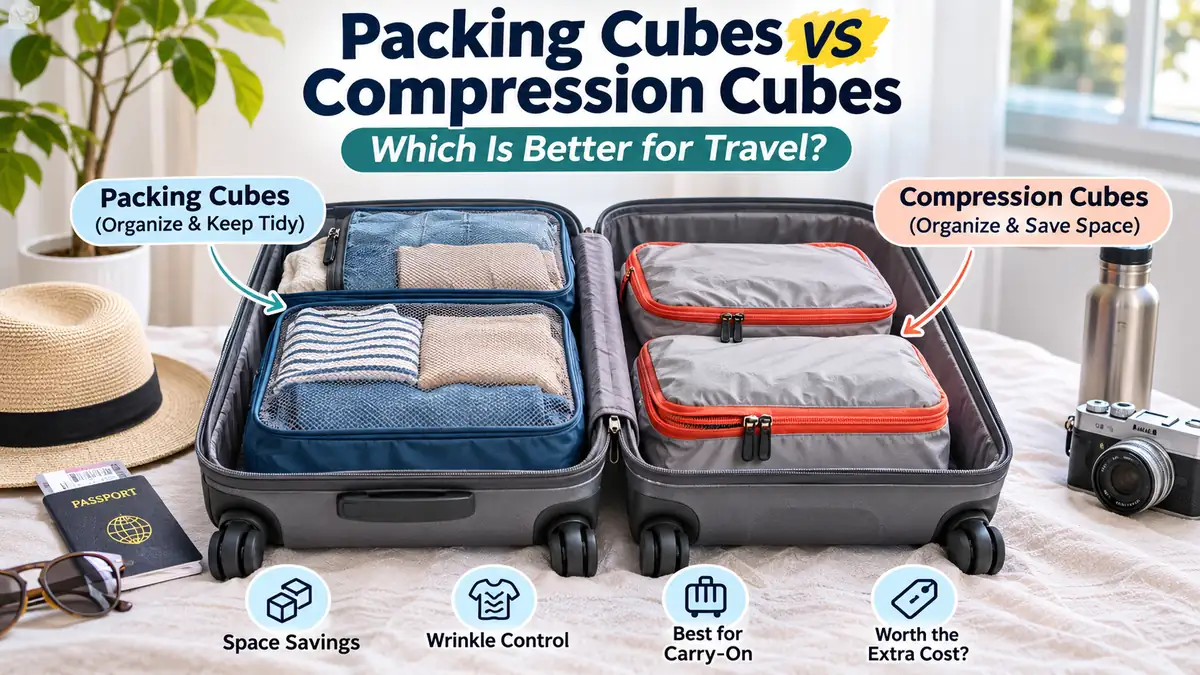
Regular packing cubes promise a tidier suitcase. Compression cubes claim to do that while squeezing clothing into less space. Both sound useful, but there’s a difference between organizing your belongings and actually reducing the space they occupy.
The packing cubes vs compression cubes debate comes down to what you’re packing, how often you unpack, and whether you’re running out of space or simply struggling to stay organized.
For a weekend trip, ordinary cubes may be all you need. For a week of travel with sweaters, casual clothes, and a single carry-on, compression cubes might provide more flexibility. Neither solves every packing problem.
In this guide, we’ll compare seven practical differences, explain how compression works, look at the space-saving claims, and help you decide which organizers make sense for your suitcase or travel backpack.
We’ll also cover vacuum bags, wrinkles, packing techniques, and the features worth checking before spending money.
When comparing packing cubes vs compression cubes, the most important question is whether you need better organization or additional space for bulky clothing. Your luggage size and travel habits should guide that decision.
Quick answer: Choose regular packing cubes for simple organization, easy access, and frequent unpacking. Choose compression packing cubes when bulky, compressible clothing is taking up too much room. If you travel often, a combination of both may be the most useful setup.
Packing Cubes vs Compression Cubes: Quick Comparison
Both accessories divide your luggage into smaller compartments. The main difference is how they handle volume.
| Feature | Regular Packing Cubes | Compression Packing Cubes |
|---|---|---|
| Main purpose | Organize clothing | Organize and reduce packed thickness |
| Zipper design | Usually one main zipper | Main zipper plus compression zipper |
| Space savings | Mostly from better organization | Can reduce volume for suitable clothing |
| Ease of packing | Simple | Takes an additional step |
| Clothing access | Usually easier | May require releasing compression |
| Wrinkle risk | Depends on packing method | May increase with excessive compression |
| Weight | Often lighter | Often slightly heavier |
| Price | Generally more affordable | Usually costs more |
| Best use | Short trips and frequent unpacking | Carry-on travel and bulky soft clothing |
| Biggest limitation | Doesn’t substantially compress contents | Can’t create extra luggage weight allowance |
The differences sound straightforward until you start using the cubes. A compression cube that becomes a stiff, rounded package may be harder to fit into a shallow suitcase compartment than a regular cube packed neatly.
That’s why the packing cubes vs compression cubes choice should begin with your luggage dimensions and packing habits.
What Are Regular Packing Cubes?
Regular packing cubes are lightweight fabric containers designed to organize clothes and smaller travel essentials inside luggage.
They usually have a rectangular shape, a zipper opening, and sometimes a mesh panel that makes the contents easier to identify.
Instead of mixing socks, shirts, underwear, and sleepwear in one suitcase compartment, you can separate them into individual cubes.
For example, you might use a medium cube for shirts, another for pants, and a smaller one for underwear.
When you arrive at your hotel, you can remove the cubes and place them directly inside a drawer.
There’s no need to unpack every item.
Do Regular Packing Cubes Save Space?
Not necessarily in a measurable way.
Regular cubes primarily improve organization. They may help you use available suitcase space more efficiently because they keep clothing grouped into predictable shapes.
They can also prevent loose garments from spreading into other compartments.
But the fabric and air inside your clothing don’t disappear simply because you put everything into a cube.
This distinction matters when comparing packing cubes vs compression cubes.
Regular organizers help you control where your clothes go. Compression models can additionally reduce the thickness of some packed clothing.
When Regular Cubes Make Sense
A simple set is often enough for a three-day business trip, family vacation, or weekend getaway.
They’re especially convenient if you change hotels frequently and want to find particular clothes without disturbing everything else.
If your suitcase already closes comfortably, you may gain more convenience from ordinary cubes than from paying extra for compression.
What Are Compression Packing Cubes?
Compression packing cubes are organizers that include an additional mechanism, usually a second zipper, to squeeze packed clothing into a smaller volume.
They resemble regular packing cubes when fully expanded.
After loading your clothes and closing the main zipper, you fasten the additional compression zipper around the cube.
This draws the fabric panels closer together, pressing down on the clothing inside.
The result is a flatter package when the contents compress successfully.
Compression packing cubes for travel are particularly useful with soft, bulky clothing such as T-shirts, leggings, casual sweaters, and some lightweight layers.
They are less effective with rigid objects or garments that have already been packed tightly.
How Do Compression Packing Cubes Work?
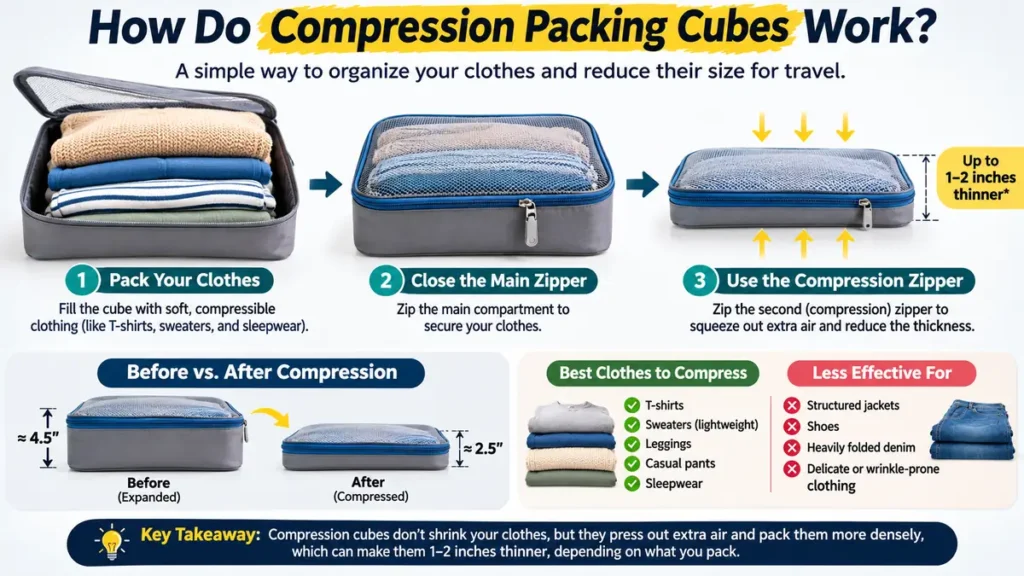
Think about a loosely folded cotton T-shirt.
The fabric itself occupies space, but there are also air gaps between the folds.
When you close a compression zipper, it pushes the clothing together and reduces some of those gaps.
The fabric doesn’t become physically smaller. You’re simply packing it more densely.
Here’s the normal process:
- Open both the main compartment and compression zipper.
- Fill the expanded cube with suitable clothing.
- Close the main zipper.
- Arrange the fabric so it lies relatively evenly.
- Close the compression zipper gradually while keeping loose material away from the zipper teeth.
- Check whether the compressed cube still fits neatly into your bag.
If closing the second zipper requires excessive force, remove an item.
Forcing it can strain the zipper, seams, and clothing.
Understanding how compression packing cubes work helps explain why results vary so much between travelers.
Packing Cubes vs Compression Cubes: 7 Key Differences
The biggest differences go beyond how many inches you can squeeze out of your suitcase.
1. Space Savings
Compression cubes have the advantage when clothing contains enough air and loosely packed material to compress.
A stack of casual cotton shirts, for instance, may become noticeably flatter.
Regular cubes don’t have the extra compression mechanism.
However, a loosely packed compression cube may save little space, and a heavily overfilled one may become awkwardly shaped.
Independent tests have produced mixed findings. Travel + Leisure reported useful thickness reductions with certain products, while Which? found less convincing overall space-saving results in its suitcase-packing tests.
The practical lesson is simple: compression isn’t a guaranteed increase in suitcase capacity.
If your bag is already efficiently packed with dense clothing, the improvement may be modest.
2. Organization and Accessibility
Regular cubes usually make accessing clothes easier.
Open the zipper, take out what you need, and close it again.
With a compressed cube, you may need to open the outer zipper first, then the main compartment.
After removing an item, you’ll have to recompress the contents.
That can become annoying during a trip with several hotel changes.
When choosing between packing cubes vs compression cubes, think about how often you’ll need to reach inside each organizer.
Compression suits clothing you won’t need immediately. Regular cubes are convenient for everyday items.
3. Wrinkles and Clothing Care
Compression cubes can increase pressure on clothing.
Whether that results in more wrinkles depends on fabric, folding method, moisture, and how tightly items are packed.
Soft activewear may tolerate compression well.
Linen shirts, tailored trousers, and delicate fabrics are another story.
If a shirt wrinkles easily, placing it in a tightly compressed cube probably won’t help.
Regular cubes give you more freedom to pack delicate items loosely.
My recommendation: Reserve compression for casual, wrinkle-resistant clothing. Use standard cubes or a garment-friendly packing method for business attire.
4. Weight and Airline Limits
Compression can make your clothes occupy less space, but it does not meaningfully reduce their weight.
A suitcase containing 22 pounds of clothing still contains roughly 22 pounds of clothing after compression, apart from the organizer’s additional weight.
This distinction is easy to overlook.
You may suddenly have room for another sweater or pair of jeans, but adding more items increases the total weight.
If your airline enforces a carry-on weight allowance, a neatly compressed suitcase can still be overweight.
Compare the empty weight of regular and compression cubes, too. Compression models may use extra zippers and heavier materials.
5. Suitcase Fit and Shape
Regular cubes tend to form predictable rectangular packages.
This makes them easy to arrange in a suitcase, especially when you own a set of coordinated sizes.
Compression cubes can become flatter, but they may also bulge in the middle if overpacked.
A dense, rounded cube can leave unusable gaps around the edges of your luggage.
This is one reason the packing cubes vs compression cubes comparison doesn’t have a universal winner.
The most useful organizer is the one that fits your suitcase’s actual shape.
6. Price and Durability
Regular packing cubes are mechanically simple.
They usually have fewer zippers and less structural strain during use.
Compression cubes often cost more because of the additional zipper, reinforced seams, and sometimes more substantial fabric.
Neither design is automatically more durable.
A well-made compression cube can outlast a poorly constructed regular cube.
Pay attention to zipper quality, stitching, and fabric strength rather than assuming one type is better based on its label.
7. Best Travel Situations
Regular cubes are convenient for short trips, family packing, and travelers who open their luggage frequently.
Compression cubes can be helpful for longer trips, limited carry-on space, and bulky but flexible clothing.
A hybrid setup often makes sense.
Use a compression cube for sweaters or extra clothing, then keep underwear, socks, and daily essentials in smaller regular cubes.
You get organization without having to compress everything.
Do Compression Packing Cubes Really Save Space?
Yes, they can, but the result depends on what you’re packing and how you measure success.
A compression cube may become significantly thinner after you close the outer zipper.
That doesn’t necessarily mean your entire suitcase uses proportionally less space.
For example, compressing one cube may leave an awkward gap that another item cannot fill.
The cube might also expand sideways as its height decreases.
This matters because suitcase capacity is three-dimensional.
A thinner organizer isn’t automatically a better fit.
What Independent Testing Suggests
Travel + Leisure’s 2026 testing found that certain compression cubes became approximately one or two inches thinner when packed appropriately.
Good Housekeeping also measures how much a cube changes in size under a standard load during its evaluations.
Yet Which?’s packing research was less favorable toward the benefits of compression cubes.
These findings aren’t necessarily contradictory. They involve different products, loads, and methods.
That’s why claims such as “saves 50% of your suitcase space” shouldn’t be treated as universal.
Clothing That Compresses Well
- Cotton T-shirts
- Leggings
- Lightweight sweaters
- Casual sleepwear
- Soft sportswear
- Some base layers
Clothing That Compresses Poorly
- Structured jackets
- Shoes
- Hard-sided accessories
- Heavily folded denim
- Delicate garments that wrinkle easily
- Clothing already packed very tightly
For most travelers, the question isn’t simply do compression packing cubes work?
A better question is whether they help with the specific clothing you’re taking.
Are Compression Packing Cubes Worth It?
Compression cubes are worth considering when luggage space is a recurring problem.
Suppose you travel with a carry-on suitcase for five or six days. You pack casual shirts, underwear, sleepwear, and a few additional layers.
A medium compression cube may help make those clothes easier to fit alongside shoes and toiletries.
That is a useful benefit.
Now imagine a two-night business trip with one suit, two dress shirts, and a pair of shoes.
You probably won’t gain much from compressing the clothing. You might even create more wrinkles.
In that situation, ordinary cubes may be the better purchase.
When the Extra Cost Makes Sense
Compression packing cubes are worth it when you regularly pack soft clothes into compact luggage and appreciate a little extra flexibility.
They can also be useful when you want to separate clean clothing from worn clothing during a longer trip.
But if you travel lightly and rarely struggle to close your suitcase, don’t feel obligated to upgrade.
When They Aren’t Worth It
Skip compression if your clothes already fit easily, you need quick access, or you’re mostly packing delicate items.
Also avoid assuming that buying more compression cubes means you should fill every one.
Unused space can be useful, especially when you bring souvenirs home.
Packing Cubes vs Compression Bags: What’s the Difference?
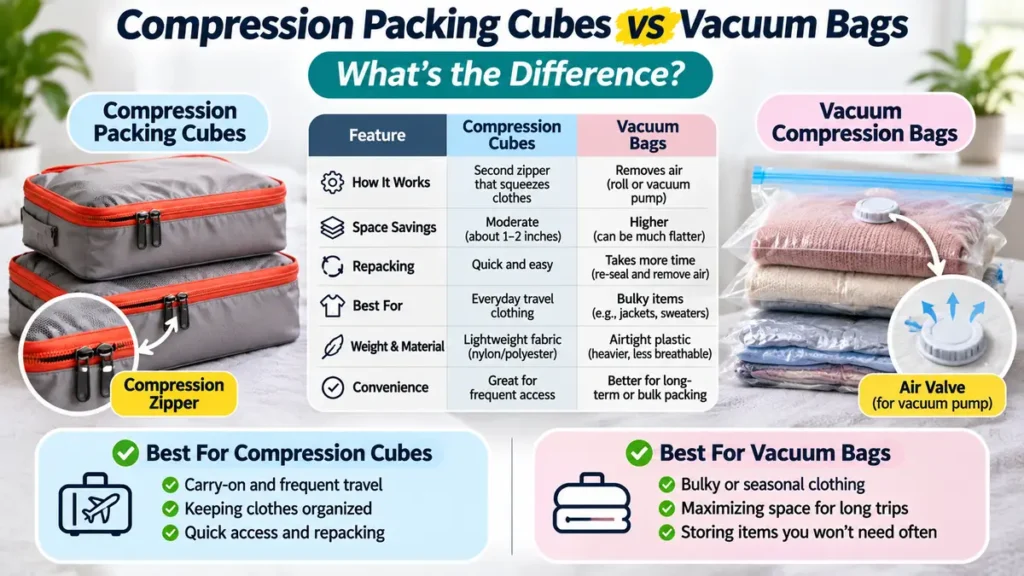
The names can be confusing because compression cubes and compression bags are not always the same product.
Most compression packing cubes use fabric panels and a zipper to squeeze clothing together.
Compression bags often use plastic or airtight materials designed to remove air.
Some bags are rolled to push air out. Others work with a vacuum cleaner or separate pump.
They can provide stronger compression for suitable items, but they introduce different trade-offs.
Compression Packing Cubes vs Vacuum Bags
| Feature | Compression Cubes | Vacuum Compression Bags |
|---|---|---|
| Material | Usually woven fabric | Usually airtight plastic |
| Method | Second zipper | Air removal by rolling or pump |
| Organization | Good | Depends on bag design |
| Repacking | Usually simple | May require repeating air-removal process |
| Best contents | Everyday soft clothing | Bulky items that compress substantially |
| Wrinkle considerations | Can increase pressure | Can create more intense creasing |
| Breathability | Fabric-dependent | Usually limited when sealed |
| Best travel use | Frequent carry-on travel | Selected bulky loads and longer storage |
Vacuum bags can be useful for packing a bulky jacket or other soft items, but they are not automatically better for daily travel.
They may also make it tempting to overpack.
When comparing packing cubes vs compression bags, regular cubes win on simplicity and quick clothing access. Compression bags may offer stronger volume reduction when that matters more.
Compression Cubes vs Vacuum Bags for Carry-On Travel
For most ordinary carry-on trips, I would start with fabric cubes.
They’re easier to open and repack, and they don’t depend on a separate device.
Vacuum bags can still work, especially roll-to-compress styles, but the packing system becomes less convenient if you need to open the bag regularly.
Airport security officers may also need to inspect packed items. Keep your luggage organized enough to open and repack without difficulty.
Which Is Better for Carry-On Luggage?
For carry-on travelers, packing cubes vs compression cubes is a practical choice. Regular cubes simplify access to clothing, while compression cubes can help reduce bulk when every inch of luggage space matters.
A carry-on creates a different problem from a large checked suitcase.
You have limited space, but you also want easy access to things you may need during your journey.
Regular packing cubes are useful for organizing clothes without complicated repacking.
Compression packing cubes for carry-on luggage become appealing when you’re trying to fit an extra layer or two into a small suitcase.
The best choice depends on your packing habits.
If you’re traveling with a single carry-on, choosing the right bag matters just as much as packing efficiently. Read our Personal Item Backpack: 11 Smart Buying Tips guide to understand backpack size, compartments, and airline restrictions.
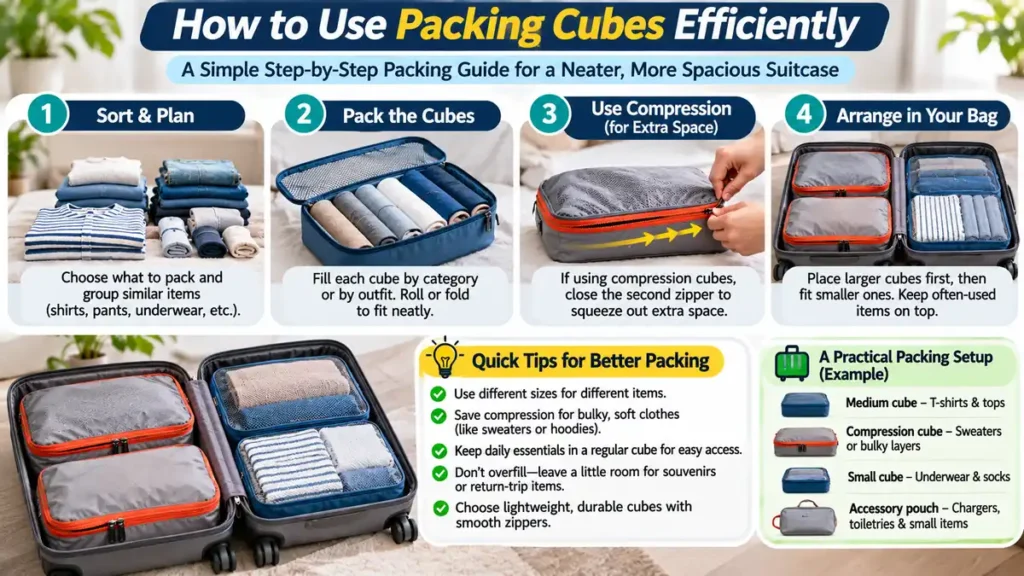
A Practical Carry-On Setup
Consider using:
- One medium compression cube for clothing that won’t be needed immediately.
- One small regular cube for underwear and socks.
- One separate pouch for chargers and other accessories.
- One accessible compartment for travel documents and essentials.
This setup avoids compressing every item while still using space efficiently.
Can You Use Compression Cubes in a Personal Item Backpack?
Yes, provided they fit.
However, a backpack’s shape differs from a rectangular carry-on suitcase.
A cube that’s ideal for a suitcase may be too wide or too rigid for a smaller backpack.
If you’re using a personal item backpack, measure the interior compartment before buying.
Look for slim or small compression cubes rather than automatically purchasing a large set.
For additional backpack selection advice, explore our Personal Item Backpack: 11 Smart Buying Tips guide on ApnarChoice.com.
Add the published article’s exact internal URL in WordPress.
Packing Cubes for Suitcases vs Backpacks
A suitcase opens flat, allowing you to see several packing cubes at once.
Backpacks often have deeper or narrower compartments.
That means cube shape matters.
For Suitcases
Rectangular cubes in different sizes are generally easy to arrange.
A larger cube can hold shirts, while smaller cubes fit into remaining spaces.
Compression is useful if the suitcase has a shallow compartment where a flatter organizer fits better.
For Travel Backpacks
Choose slimmer cubes that match the width of the main compartment.
A few well-chosen organizers may work better than an entire multi-piece set.
Leave some room for toiletries, electronics, and items you need quickly.
For Backpacking
Weight and accessibility matter more.
Compression packing cubes for backpacking may be helpful for soft clothing, but heavier organizers can add unnecessary ounces.
A simple lightweight organizer or stuff sack may be more practical in certain backpacks.
The packing cubes vs compression cubes decision changes with the bag you’re using.
How to Use Packing Cubes Efficiently
Even a good set of organizers won’t fix an inefficient packing method.
Start with the clothes you’ll actually wear, not the number of cubes available.
Step 1: Plan Outfits Before Packing
Choose clothes that work together.
A few versatile items generally create more outfit combinations than several unrelated pieces.
This helps reduce unnecessary clothing before compression enters the picture.
Step 2: Group Similar Items
Place underwear, shirts, sleepwear, and other categories into separate cubes.
You could also organize by outfit or by day if that suits your trip.
For family travel, separate colors or labels can help identify each person’s belongings.
Step 3: Fold or Roll Based on the Fabric
Rolling can work well for casual clothing.
Flat folding may be more suitable for structured garments.
Neither method is always superior.
Use the approach that keeps clothes manageable and fits the organizer without excessive pressure.
Step 4: Avoid Overfilling
A cube should close without forcing the zipper.
If the fabric pulls tightly across the seams, remove an item or use a larger size.
For compression cubes, close the main zipper first and then compress gradually.
Step 5: Arrange Cubes Before Adding Loose Items
Place the largest cubes in the suitcase first.
Fit smaller organizers into the remaining spaces.
Use gaps for soft accessories where practical.
Step 6: Leave Room for the Return Trip
Laundry, souvenirs, and items purchased during travel can change your packing needs.
Leaving a little free space makes repacking less stressful.
These simple habits may improve your luggage organization more than buying a more expensive set.
Best Compression Packing Cubes for Travel: What to Look For
The phrase best compression packing cubes for travel can lead you toward dozens of competing products.
Instead of starting with brand names, begin with product construction and fit.
Strong, Smooth Zippers
Compression creates pressure on the zipper track.
Look for smooth operation and well-secured stitching around the zipper.
A cube that repeatedly snags while closing can become frustrating.
Lightweight but Durable Fabric
Nylon and polyester are common materials.
Lightweight construction is helpful, especially for travelers with strict luggage limits.
However, the fabric should still feel strong enough for repeated packing.
Useful Sizes
A practical set might include one medium cube and two small cubes.
A large set containing many organizers isn’t necessarily better.
Consider how many cubes actually fit in your luggage.
Visibility
Mesh panels help you identify contents without opening each cube.
Solid fabric may offer more privacy and can be convenient for certain types of clothing.
Neither design is automatically superior.
Compression That Works Without Force
A well-designed compression cube should close with reasonable pressure when loaded appropriately.
If the zipper only works when you wrestle with the bag, the setup may be too full.
Washability and Care
Check manufacturer instructions for cleaning.
Travel organizers can collect dust, fabric lint, and occasional spills.
Choose materials that are practical to maintain.
Warranty and Returns
Review return policies before buying, especially for expensive sets.
It helps to check whether the manufacturer covers broken zippers or defective seams.
For the best packing cubes for travel, reliable construction matters more than an impressive list of accessories you won’t use.
Packing Cubes vs Compression Cubes: Which Should You Buy?
By now, the choice becomes less about which product sounds more advanced and more about what you need from it.
Here’s how I’d approach several common situations.
Weekend Getaway
Choose regular packing cubes.
You probably won’t have enough clothing to benefit significantly from compression, and quick access is useful.
One-Week Carry-On Trip
Choose a combination.
Use compression for bulky casual clothing and standard cubes for the essentials you’ll access most often.
Business Travel
Regular cubes are usually the safer choice for shirts, workwear, and other garments you don’t want to crease heavily.
Use compression only for appropriate casual layers.
Family Vacation
Regular cubes make it easy to separate clothing by person.
Compression can be helpful for selected bulky items, but organization is likely to deliver the biggest everyday benefit.
Backpack-Only Travel
Choose small, lightweight cubes that fit the bag.
Compression can be helpful, but avoid filling your backpack with hard, overstuffed blocks.
Winter Travel
Compression cubes may help with softer layers such as sweaters and base layers.
Large coats, shoes, and rigid winter gear may still take substantial space.
Long Trips With Multiple Stops
Regular cubes offer convenience if you’re unpacking and repacking frequently.
If capacity is limited, one compression cube for spare clothing can provide a useful compromise.
My recommendation: Most travelers don’t need to choose one type exclusively. A small mixed set can work better than using compression for everything.
Common Packing Cube Mistakes
A few mistakes can make either type of organizer less useful.
Buying cubes before measuring luggage. A cube that fits a 28-inch suitcase may be awkward inside a small backpack.
Using compression for wrinkle-prone clothing. Save it for garments that tolerate pressure.
Overfilling every compartment. Compression is no substitute for deciding what you actually need.
Ignoring total weight. Reducing volume doesn’t reduce the weight of your packed clothing.
Buying too many cubes. More compartments can create clutter rather than solve it.
Forcing zippers closed. Repeated pressure can damage seams and zipper tracks.
Leaving wet clothes compressed. Damp clothing stored without adequate drying can develop odors and other problems.
Assuming vacuum bags and compression cubes are identical. Their construction, operation, and repacking convenience differ.
Good packing begins with sensible choices, not a large collection of organizers.
Frequently Asked Questions
Are packing cubes worth it?
Yes, if organization matters to you. They make clothing easier to separate, locate, and move between luggage and hotel drawers. They may offer limited direct volume savings, however.
Do packing cubes save space?
Regular packing cubes can help you arrange clothing more efficiently, but they don’t substantially compress it. Compression cubes may reduce occupied volume for soft, bulky garments.
Do compression packing cubes work?
Yes, many compression cubes successfully reduce the thickness of packed clothing. The overall benefit depends on the fabric, amount packed, cube shape, and luggage dimensions.
Are compression packing cubes worth it?
They can be worth the additional cost for carry-on travelers who frequently pack bulky clothing. They offer less value when your suitcase already has enough room.
How do compression packing cubes work?
Most use a second zipper that draws the top and bottom panels closer together. This pushes clothing into a smaller volume by reducing air gaps between garments.
What is the difference between compression cubes vs packing cubes?
Regular cubes primarily organize clothing. Compression cubes provide similar organization but add a zipper or mechanism that can make packed clothing flatter.
Are compression packing cubes better than regular packing cubes?
Not for everyone. They’re more useful when saving space is a priority. Regular cubes can be easier to use, lighter, and more convenient for frequent unpacking.
Do compression packing cubes make clothes wrinkle?
They can increase wrinkles, particularly when delicate or crease-prone clothing is packed tightly. Fabric type, folding method, and the duration of compression all matter.
Are compression packing cubes good for carry-on travel?
Yes, especially with soft clothing. They can help manage limited carry-on space, but you still need to respect airline size and weight requirements.
Are compression packing cubes better than vacuum bags?
For frequent travel, fabric compression cubes are often more convenient. Vacuum bags may reduce volume more aggressively for suitable contents but can make repacking less practical.
Can you use packing cubes in a backpack?
Yes. Choose organizers that match the backpack’s interior dimensions, and avoid rigidly overstuffing them.
How many packing cubes do you need?
For many carry-on trips, two or three carefully selected cubes are sufficient. A larger suitcase or family trip may require more.
Should you roll or fold clothes in packing cubes?
Both methods can work. Roll casual items when convenient and fold structured garments to manage creases. The best approach depends on fabric and cube shape.
Can compression packing cubes reduce luggage weight?
No. Compression reduces the space occupied by clothing, not its weight. The cube itself also adds a small amount of weight.
Are compression packing cubes better for international travel?
They can be useful on longer trips or when traveling with limited luggage capacity. The benefit depends more on your packing needs than whether the trip crosses a border.
Final Verdict
The packing cubes vs compression cubes decision isn’t about finding a product that magically creates extra luggage capacity.
It’s about choosing the right packing system.
Regular cubes make sense for travelers who value organization, easy access, and a straightforward routine. They’re often less expensive and simpler to use.
Compression cubes offer an additional advantage when soft clothing can be packed more densely. They’re particularly useful for carry-on trips, compact suitcases, and situations where a little extra room matters.
But compression has limits. It doesn’t reduce luggage weight, it can increase wrinkles, and an overstuffed cube may fit poorly.
If you’re buying your first set, start with a few organizers that match your luggage. Consider adding one compression cube if bulky clothing regularly creates a problem.
The best packing system is the one that lets you find what you need, close your bag comfortably, and travel without continually rearranging everything.
Sources and Further Reading
The following resources informed this comparison.
- Travelpro: Packing Cubes vs Compression Cubes
- Travel + Leisure: Best Compression Packing Cubes of 2026
- Travel + Leisure: Best Packing Cubes for Travel
- Good Housekeeping: Best Packing Cubes
- Which?: How to Pack a Suitcase Efficiently
- Pack Hacker: Best Packing Cubes Guide
- Consumer Reports: Best Packing Cubes
Editorial disclosure: ApnarChoice.com has not independently tested the products discussed in this comparison. The recommendations reflect product design differences, published third-party testing, and practical packing considerations. Product features, availability, and prices may change.