On This Page
A television that nearly fills your living-room wall can change the way you experience movies, sports, and video games. With a screen approaching 100 inches, even ordinary streaming content feels larger and more immersive.
But choosing the best 100 inch TV requires more research than buying a conventional 55-inch or 65-inch television.
Picture quality matters, of course. So do brightness, contrast, motion handling, and gaming features. At this size, however, you also need to consider wall dimensions, furniture, delivery access, installation costs, and viewing distance.
There’s another detail shoppers often overlook: a 98-inch television isn’t the same size as a 100-inch television. Both compete in the same giant-screen category, but their physical dimensions and available models differ.
Finding the best 100 inch TV therefore means comparing both true 100-inch televisions and high-quality 98-inch alternatives.
For this 2027 buying guide, we’ve selected seven large-screen TVs from TCL, Hisense, Sony, and Samsung. The recommendations cover premium picture quality, value, home theater performance, bright-room viewing, and gaming.
Quick recommendation: The TCL X11L is a compelling premium choice, while the TCL QM8K provides excellent overall value. If you specifically want a true 100-inch screen, the Hisense U8QG deserves serious consideration. The TCL QM6K is a practical budget alternative.
These selections are based on published independent reviews and manufacturer specifications available through November 16, 2026. ApnarChoice has not personally tested these televisions. Prices, availability, and product rankings should be reviewed as additional 2027 models reach the US market.
Best 100 Inch TV: Quick Comparison
Before reviewing the individual models, compare the seven televisions below.
| TV Model | Screen Size | Display Technology | Refresh Rate | Best For |
|---|---|---|---|---|
| TCL X11L | 98 inches | Premium Mini LED LCD | 144Hz | Premium picture quality |
| TCL QM8K | 98 inches | QD-Mini LED | 144Hz | Overall value |
| Hisense U8QG | 100 inches | Mini LED LCD | 165Hz | True 100-inch home theater |
| TCL QM6K | 98 inches | QD-Mini LED | 144Hz | Budget shoppers |
| Sony BRAVIA 5 | 98 inches | Mini LED LCD | 120Hz | Movies and upscaling |
| Samsung QN90F | 98 inches | Neo QLED Mini LED | Up to 165Hz | Reflection control |
| Hisense U7SG | 100 inches | Mini LED LCD | Up to 165Hz | Newer true 100-inch alternative |
Important: Refresh-rate figures describe supported panel capabilities, not the frame rates of ordinary movies or TV broadcasts. Features and performance can also vary by screen size.
Our recommendations don’t assume that the largest or most expensive television is automatically the best 100 inch TV for every household.
1. TCL X11L: Best Premium 98-Inch TV Overall
Best for: Buyers who prioritize outstanding image quality, brightness, and premium home theater performance.
The TCL X11L is one of the strongest options in the premium giant-screen television market.
Although its display measures 98 inches rather than exactly 100 inches, it competes directly with true 100-inch models.
Its advanced backlight system, high brightness, and strong contrast make it especially appealing for large living rooms.
Picture Quality
The TCL X11L uses premium Mini LED technology to control brightness across different areas of the display.
This helps it reproduce deep-looking dark scenes while keeping bright elements vivid.
Imagine watching a science-fiction movie featuring a dark spacecraft against a field of stars.
A television with poor backlight control may produce obvious glowing areas around bright objects.
The X11L is designed to reduce this effect and maintain convincing contrast.
Its picture quality also remains impressive in brighter environments.
That makes it suitable for a large family living room where lighting conditions change throughout the day.
Movies and HDR Performance
The X11L supports Dolby Vision and HDR10+.
These formats help compatible televisions interpret HDR content.
However, format support is only part of the story. Actual brightness, contrast, color reproduction, and processing determine the final result.
Independent testing has praised the X11L’s powerful HDR presentation and strong reflection handling.
Gaming Performance
The television supports 4K at up to 144Hz with compatible equipment.
It also provides four HDMI 2.1 inputs and VRR support.
These features make it suitable for PS5, Xbox Series X, and gaming PCs.
Its gaming motion is good for a large LCD television, although OLED displays can still provide clearer pixel transitions.
Pros
- Excellent overall picture quality
- Very high brightness
- Strong Mini LED local dimming
- Impressive HDR performance
- Four HDMI 2.1 gaming connections
- Good reflection handling
Cons
- High purchase price
- 98 inches rather than exactly 100 inches
- Built-in audio may not satisfy serious home theater buyers
- Requires substantial installation space
Who Should Buy It?
If you’re searching for the best 100 inch TV category and picture quality matters more than an exact two-inch size difference, the TCL X11L should be near the top of your list.
Verdict: A premium giant-screen television for buyers who want impressive picture performance and are prepared to invest in a complete home theater setup.
2. TCL QM8K: Best 100 Inch TV Alternative for Overall Value
Best for: Buyers who want high-end picture quality without paying flagship prices.
The TCL QM8K is a particularly attractive 98-inch option because it combines strong brightness, local dimming, HDR support, and gaming features.
For many households, this may be the more sensible purchase than spending considerably more on a flagship television.
Why the QM8K Stands Out
The QM8K delivers very good contrast for a large Mini LED television.
Its local dimming system helps dark scenes appear deep while maintaining bright highlights.
That matters when watching movies in a room with controlled lighting.
It also provides substantial brightness for daylight viewing.
The television’s glossy screen helps reduce the intensity of some reflections, although you should still avoid placing bright lamps directly opposite the display.
HDR and Color Performance
The QM8K supports Dolby Vision and HDR10+.
Its quantum-dot technology helps produce vivid colors.
Compared with lower-cost models, the QM8K offers stronger HDR impact and improved backlight control.
This makes it a good choice for action movies, nature documentaries, and premium streaming content.
Gaming Features
The 98-inch QM8K supports high-refresh-rate gaming, VRR, and HDMI 2.1 connectivity.
It can handle compatible 4K 120Hz console gaming and higher refresh rates from supported PCs.
That gives it considerable flexibility as a family entertainment television.
Pros
- Excellent picture performance for its category
- Strong brightness and contrast
- Good HDR format compatibility
- High-refresh-rate gaming
- Effective local dimming
- Better value than many flagship models
Cons
- Still requires a substantial budget
- Not as advanced as the X11L
- Two HDMI 2.1 gaming inputs rather than four
- Large-screen delivery and installation remain challenging
Who Should Buy It?
Consider the QM8K if you want the best 100 inch TV experience without spending the maximum possible amount.
Although the screen is technically 98 inches, the visual difference between 98 and 100 inches is relatively small at normal home-theater distances.
Verdict: An excellent large-screen value proposition. Compare its current price against newer models before deciding.
3. Hisense U8QG: Best True 100-Inch Premium TV
Best for: Buyers who specifically want a full 100-inch screen with powerful brightness and advanced gaming features.
The Hisense 100U8QG has one important advantage over the first two televisions: it is genuinely a 100-inch model.
If your goal is to buy a television with a 100-inch advertised diagonal, this model deserves attention.
It combines Mini LED backlighting with strong brightness, deep contrast, and modern gaming connectivity.
Picture Quality
The 100U8QG produces exceptionally bright images.
This can be useful for large living rooms where sunlight makes darker televisions difficult to watch.
Its Mini LED system also creates deep blacks with relatively limited haloing around bright objects.
This combination makes it suitable for both dark-room movies and daytime entertainment.
However, the screen’s reflection handling isn’t perfect.
Direct reflections from nearby windows or lamps may still be noticeable.
Picture Processing
The television performs well when improving lower-resolution content.
That matters because not everything you watch on a 100-inch screen is native 4K.
Older movies, cable broadcasts, and compressed video can look less impressive when stretched across such a large display.
Good processing helps reduce visible imperfections.
Gaming Performance
The U8QG supports up to 4K 165Hz, VRR, and HDMI 2.1 features.
Its input lag is low, making controls feel responsive.
However, independent testing identified relatively slow pixel transitions.
As a result, fast-moving objects may appear blurrier than on some competitors.
A Size-Specific Warning
The 100-inch U8QG does not perform identically to every smaller U8QG model.
Independent comparisons have found differences in color performance and brightness.
Do not rely exclusively on a review of the 65-inch version when buying the 100-inch television.
Pros
- Genuine 100-inch screen
- Excellent brightness
- Deep Mini LED contrast
- Dolby Vision and HDR10+ support
- Strong gaming connectivity
- Good processing of lower-quality video
Cons
- Narrow viewing angles
- Motion blur in fast-moving scenes
- Direct reflections can remain distracting
- Some screen-uniformity issues
- Size-specific performance differences
Who Should Buy It?
For anyone researching a Hisense 100 inch TV, the U8QG is a strong premium candidate.
It’s especially appealing when exact screen size and high brightness are important.
Verdict: A capable true 100-inch television with strong home-theater performance, although buyers who prioritize motion clarity should also compare the TCL QM8K.
4. TCL QM6K: Best Budget 98-Inch TV
Best for: Buyers who want an enormous screen without spending premium flagship money.
The TCL QM6K brings Mini LED technology into a more affordable giant-screen category.
Its 98-inch version offers 4K resolution, local dimming, and high-refresh-rate gaming support.
For buyers who mainly want a cinematic screen size, it represents a practical alternative to expensive high-end televisions.
Picture Quality
The QM6K produces respectable contrast for its price category.
Its local dimming system helps reduce the flat, gray-looking blacks sometimes seen on basic LCD displays.
However, it cannot match the contrast precision and HDR impact of the more expensive QM8K.
Bright subtitles or objects against dark backgrounds may produce more noticeable blooming.
This limitation becomes more visible on a very large screen.
Bright-Room Performance
The QM6K combines useful brightness with a screen finish intended to reduce distracting reflections.
It can work well in many ordinary living-room environments.
However, buyers with very bright rooms may prefer a higher-end model.
Gaming Features
The QM6K supports 4K 120Hz gaming, VRR, and HDMI 2.1 functionality.
Its maximum refresh rate reaches 144Hz with compatible devices.
This makes it suitable for PlayStation 5, Xbox Series X, and many PC gaming setups.
Pros
- Relatively affordable giant-screen option
- 98-inch 4K display
- Mini LED local dimming
- High-refresh-rate gaming support
- Dolby Vision and HDR10+ compatibility
- Good feature selection for the price
Cons
- More visible blooming than premium models
- Lower HDR brightness than the QM8K
- Less impressive overall picture quality
- Still expensive to transport and install
Who Should Buy It?
If you’re searching for the best 100 inch TV on a tighter budget, the TCL QM6K is one of the most logical models to investigate.
It provides a very large screen while avoiding the cost of premium flagship displays.
Verdict: A sensible budget recommendation for buyers who value screen size and useful features more than ultimate picture quality.
5. Sony BRAVIA 5: Best 98-Inch TV for Movies and Upscaling
Best for: Movie enthusiasts, cable-TV viewers, and households watching a mixture of high- and lower-quality content.
The Sony BRAVIA 5 is a 98-inch Mini LED television that focuses heavily on picture processing.
That matters because a giant television makes weaknesses in video quality easier to see.
A compressed broadcast that looks acceptable on a 43-inch display may appear noticeably softer on a 98-inch screen.
Sony’s processing attempts to improve the presentation of this material.
Movie Performance
The BRAVIA 5 delivers good contrast and effective image processing.
Its strengths become particularly noticeable with older films, television broadcasts, and imperfect streaming sources.
It also supports Dolby Vision on compatible video content.
The BRAVIA 5 may not produce the same extreme brightness as TCL’s top premium models, but its image processing can still make it attractive for a cinema-focused household.
Gaming and Smart Features
The television supports 4K 120Hz, VRR, and ALLM on compatible connections.
It uses Google TV, offering access to major streaming applications.
Sony also provides selected PlayStation-oriented features.
However, its HDMI 2.1-capable port selection is more limited than on some competitors.
Installation Considerations
Sony lists the 98-inch BRAVIA 5 at approximately 86.6 inches wide without its stand.
The television weighs approximately 152 pounds without the stand.
Its packaging is even larger and heavier.
These measurements demonstrate why delivery access and appropriate wall-mounting equipment matter.
Pros
- Strong image processing
- Good upscaling
- Dolby Vision support
- Useful movie performance
- Google TV platform
- PlayStation-related features
Cons
- More expensive than some comparable TCL models
- Lower brightness than certain premium alternatives
- Limited HDMI 2.1-capable inputs
- Very heavy installation requirements
Who Should Buy It?
The Sony BRAVIA 5 is worth considering if you watch substantial amounts of ordinary streaming, broadcast TV, and older movies.
Verdict: A processing-focused large-screen television. Its strengths are meaningful, but the QM8K often offers stronger value and overall picture performance.
6. Samsung QN90F: Best Premium 98-Inch TV for Glare Control
Best for: Large, bright living rooms with significant reflections.
The Samsung QN90F Neo QLED is available in a 98-inch version.
It combines advanced Mini LED backlighting with Samsung’s glare-reducing screen treatment.
This makes it a candidate for households where windows and overhead lighting create distracting reflections.
Bright-Room Performance
The QN90F delivers substantial brightness.
Its anti-reflection screen finish reduces many reflections that can make television viewing difficult during the day.
This is useful when a large TV is installed opposite windows or near multiple light sources.
However, its screen coating may produce a different appearance from glossy displays.
Some buyers prefer the look of glossy screens in darker rooms.
Sports and Motion
Sports performance depends on refresh rate, motion processing, response time, and screen uniformity.
The QN90F provides advanced motion features and high refresh-rate support.
But it doesn’t automatically outperform every competing television during fast action.
Independent comparisons are important, particularly if you watch football, basketball, or racing.
Gaming Features
Samsung offers HDMI 2.1 connectivity, VRR, and high-refresh-rate support.
The QN90F is capable of up to 165Hz with compatible gaming equipment.
Its gaming features make it suitable for modern consoles and PCs.
However, it does not support Dolby Vision.
Samsung instead supports formats such as HDR10 and HDR10+.
Pros
- Very high brightness
- Strong glare reduction
- Large 98-inch screen
- Advanced gaming features
- Good smart-TV functionality
Cons
- Premium price
- No Dolby Vision
- Matte screen appearance may not suit everyone
- Game Mode picture quality has some limitations
Who Should Buy It?
If you want the best 100 inch TV category for a bright family room, the Samsung QN90F deserves comparison.
Its glare-control features are particularly relevant when the room cannot easily be darkened.
Verdict: A compelling choice for bright-room buyers, although its high price means the TCL X11L and QM8K should also be considered.
7. Hisense U7SG: Best Newer True 100-Inch Alternative
Best for: Buyers interested in a 2026-generation 100-inch television with modern gaming features.
The Hisense U7SG is a 2026 Mini LED television available in several sizes, including a true 100-inch version.
It combines high brightness, local dimming, Google TV, and advanced connectivity.
However, large-screen buyers need to understand one important distinction.
The 100-Inch Screen Is Different
Independent reviews of the smaller U7SG televisions describe a matte screen that handles reflections particularly well.
The 100-inch version uses a glossy coating.
That means the reflection-handling conclusions from smaller versions do not transfer directly to the giant-screen model.
For a room facing bright windows, compare the exact 100-inch version rather than assuming it offers identical anti-glare performance.
Picture Quality
The U7SG family delivers strong contrast and vivid colors.
Its local dimming helps create deep blacks and impressive HDR highlights.
The 100-inch version includes a substantial number of local dimming zones.
But published tests of smaller models also identify motion and uniformity limitations.
Because the 100-inch hardware differs in some respects, its exact performance deserves separate verification.
Gaming Features
The U7SG series supports 4K at up to 165Hz, HDMI 2.1, and VRR.
These are attractive features for console and PC gamers.
However, a high refresh rate does not guarantee excellent motion clarity.
Pixel response and other display behavior matter too.
Pros
- True 100-inch screen
- Newer 2026 model generation
- Strong advertised brightness
- Mini LED backlighting
- Modern gaming connectivity
- Google TV
Cons
- Glossy screen on the 100-inch version
- Motion performance needs careful consideration
- Uniformity limitations reported in smaller models
- Exact-size performance may differ from available tests
Who Should Buy It?
If you’re comparing a newer Hisense 100 inch TV against discounted previous-generation models, the U7SG belongs on your shortlist.
Verdict: An interesting newer alternative, but shoppers should compare verified reviews of the exact 100-inch version before choosing it over the U8QG or TCL models.
98 Inch vs 100 Inch TV: What’s the Difference?
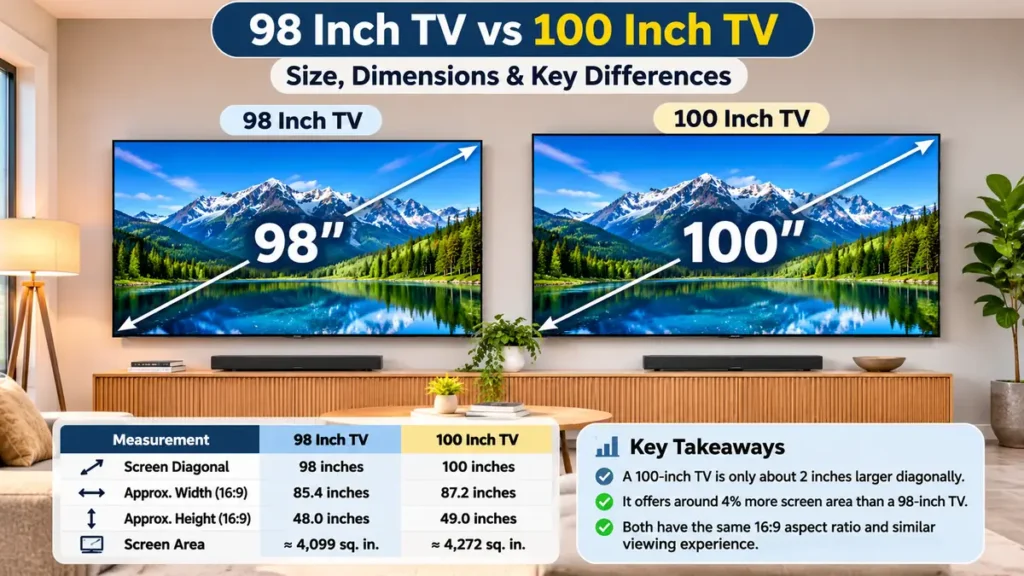
When researching the best 100 inch TV, you’ll regularly encounter 98-inch alternatives.
The numbers sound different, but the screen-size difference is relatively modest.
Both measurements describe the screen’s diagonal, not its width.
For a standard 16:9 screen:
| Measurement | 98-Inch TV | 100-Inch TV |
|---|---|---|
| Diagonal | 98 inches | 100 inches |
| Approximate Screen Width | 85.4 inches | 87.2 inches |
| Approximate Screen Height | 48.0 inches | 49.0 inches |
| Aspect Ratio | 16:9 | 16:9 |
These measurements describe the visible rectangular screen. Actual television dimensions include the bezel, chassis, and stand.
Is 100 Inches Noticeably Bigger Than 98 Inches?
A 100-inch display provides approximately 4% more screen area than a 98-inch display of the same aspect ratio.
The difference is real but relatively small.
At normal home-theater distances, picture quality is usually more important than the extra two diagonal inches.
A high-quality 98-inch television can deliver a better experience than a poorly performing 100-inch model.
Recommendation: Don’t reject a better 98-inch TV simply because its advertised size doesn’t reach exactly 100 inches.
100 Inch TV Dimensions: How Much Space Do You Need?
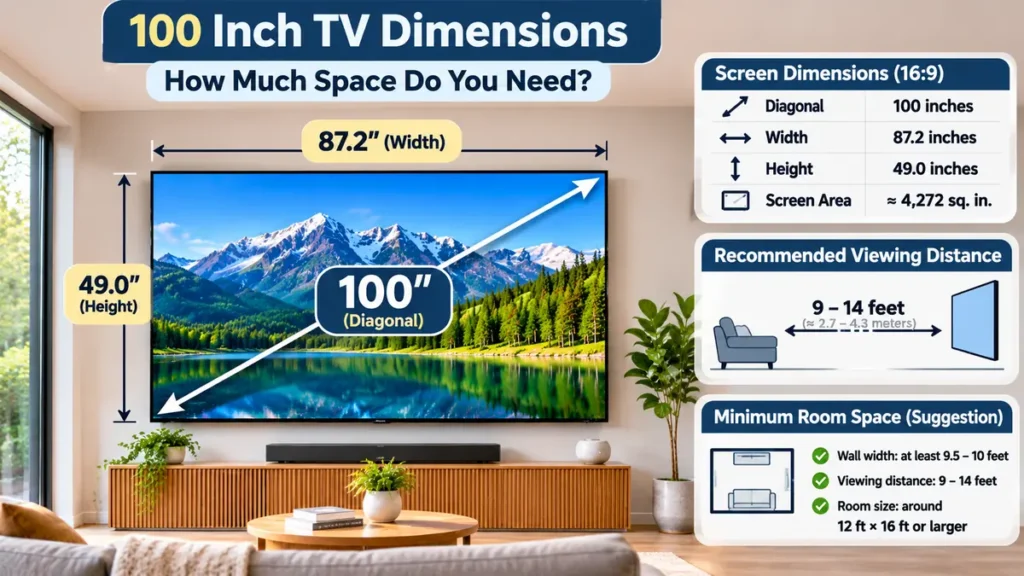
Understanding 100 inch tv dimensions is essential before purchasing.
A 100-inch 16:9 display measures approximately:
- Width: 87.2 inches
- Height: 49.0 inches
- Diagonal: 100 inches
That is approximately 7.26 feet wide and 4.09 feet high for the visible screen.
The physical television may be slightly larger.
Wall Space Requirements
A wall barely wider than the television is not necessarily suitable.
You need room for ventilation, cables, mounting hardware, and comfortable access.
Wall-mounted televisions should be installed according to manufacturer instructions and the structural requirements of the mounting surface.
TV Stand Requirements
If you’re using furniture rather than a wall mount, check the television’s stand design.
Some large TVs have feet positioned near the outer edges.
Others use a central stand or adjustable positions.
Your furniture must be able to support the full weight safely.
Delivery Measurements
The shipping carton can be considerably larger than the actual TV.
Measure doorways, staircases, hallways, elevators, and corners before placing an order.
This is especially important in apartments and older homes with narrow access routes.
For a dedicated article, 100 inch TV dimensions is also a useful topic to research separately, since installation questions have a distinct informational search intent.
Best Viewing Distance for a 100 Inch TV
A giant-screen television is most enjoyable when your seating distance matches the screen size and your preferred viewing experience.
Sit too close, and the picture may feel overwhelming.
Sit too far away, and you lose some of the immersion you paid for.
General Viewing Distance Guide
| TV Size | Approximate Starting Distance |
|---|---|
| 75 inches | 7–10 feet |
| 85 inches | 8–12 feet |
| 98 inches | 9–13 feet |
| 100 inches | 9–14 feet |
These are broad comfort guidelines, not strict rules.
For cinematic viewing, many people prefer sitting closer.
For ordinary television and sports, a slightly greater distance may feel more comfortable.
What About 4K Resolution?
Most modern giant-screen TVs support 4K resolution.
Because 4K provides substantially more detail than 1080p, it works well for large displays.
However, a bigger screen also makes low-quality content easier to notice.
Compressed video, poor upscaling, and motion artifacts can become distracting.
That’s one reason picture processing should play a major role in choosing the best 100 inch TV.
Best 100 Inch TV for Movies and Home Theater
Movies often benefit from deep contrast, accurate colors, and effective HDR.
For a dedicated home theater, the TCL X11L offers excellent premium performance.
The TCL QM8K is an attractive alternative when balancing quality and price.
The Sony BRAVIA 5 deserves attention if you watch older movies or mixed-quality video sources.
What Matters for Movie Viewing?
Contrast: Dark scenes should look deep rather than gray.
Local dimming: Bright objects should not create excessive glowing around surrounding dark areas.
HDR: Highlights should appear vivid without losing detail.
Color accuracy: Skin tones and scenery should look natural.
Processing: Lower-resolution films should remain watchable on a very large screen.
If movie nights are your main priority, the best 100 inch TV is usually the model that combines convincing contrast with good image processing.
A more expensive model isn’t always necessary if your room is dark and your content is mostly ordinary streaming.
Best 100 Inch TV for Sports
Sports viewers have different priorities.
Football, basketball, and racing involve fast movement, quick camera pans, and large areas of consistent color.
The best 100 inch TV for sports should handle motion effectively and maintain good screen uniformity.
Motion Clarity
High refresh rates can help, but response time matters too.
A television with slow pixel transitions may produce blur around fast-moving players.
Independent motion tests are especially useful.
Screen Uniformity
Large green fields and pale surfaces can reveal darker patches or uneven shading.
This is sometimes called the dirty-screen effect.
At nearly 100 inches, these imperfections may be easier to notice.
Viewing Angles
Sports are often watched with groups of friends or family.
Some LCD TVs lose contrast and color accuracy when viewers sit far from the center.
If your seating area is wide, check viewing-angle performance.
Recommendation: The TCL X11L and QM8K are strong starting points. Evaluate their motion handling and viewing angles against your seating arrangement rather than choosing by refresh rate alone.
Best 100 Inch TV for Gaming
A giant television can make racing games, open-world adventures, and cinematic action titles especially immersive.
However, screen size doesn’t automatically mean better gaming.
The best 100 inch TV for gaming should have low input lag, suitable HDMI connectivity, VRR, and acceptable pixel response times.
HDMI 2.1
For modern consoles, check whether the television supports 4K at 120Hz through the intended HDMI input.
You don’t necessarily need every HDMI port to support the same maximum bandwidth.
But if you connect several gaming systems, having more high-bandwidth inputs is convenient.
Variable Refresh Rate
VRR helps compatible televisions adjust their refresh timing to changing game frame rates.
This can reduce screen tearing and improve presentation.
Input Lag
Low input lag makes button presses feel responsive.
The television’s Game Mode generally helps reduce delays caused by unnecessary picture processing.
120Hz vs 144Hz vs 165Hz
The PS5 supports output up to 120Hz for compatible games.
Higher refresh rates mainly benefit gaming PCs capable of producing additional frames.
A well-performing 120Hz television can still be excellent for console gaming.
Gaming Recommendations
- Premium: TCL X11L
- Overall value: TCL QM8K
- Budget: TCL QM6K
- True 100-inch option: Hisense U8QG
For console-specific recommendations, read our Best TV for PS5 in 2027 guide.
100 Inch TV vs Projector: Which Is Better?
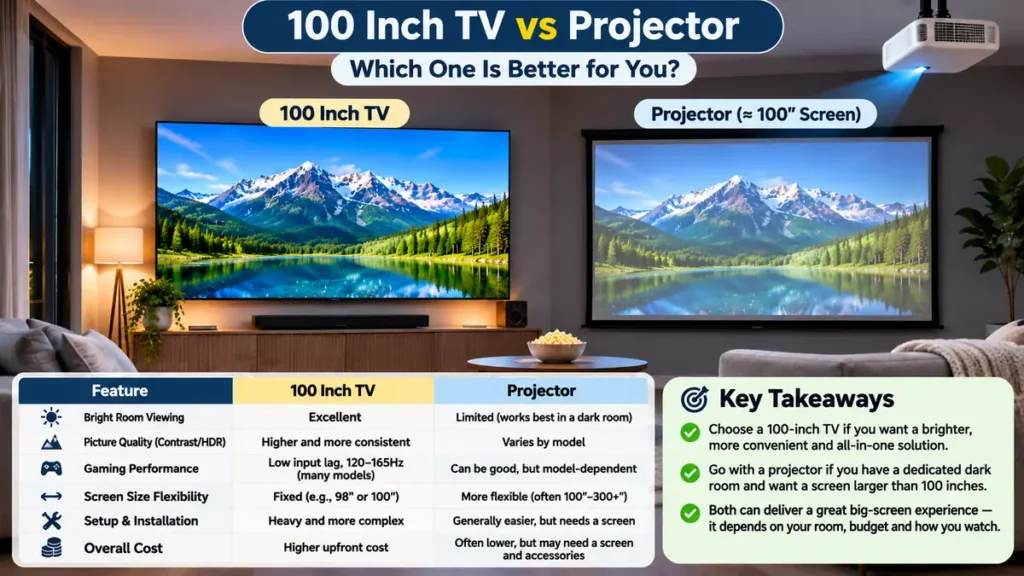
For years, projectors were the most practical way to enjoy a screen approaching 100 inches.
Today, giant televisions provide another option.
But the right choice depends on your room, budget, and viewing habits.
| Feature | 98–100 Inch TV | Projector |
|---|---|---|
| Bright-room viewing | Generally better | Often requires controlled lighting |
| Setup | Heavy installation | Requires projector and screen positioning |
| Black levels | Depends on display technology | Depends on projector and room |
| Screen size flexibility | Fixed | More flexible |
| Gaming | Many models offer strong low-latency features | Varies significantly |
| Maintenance | Generally straightforward | May involve filters or light-source considerations |
| Portability | Very limited | Some models are portable |
| Installation cost | Can be substantial | Depends on projector, screen, and mounting |
Choose a Giant TV If…
You watch during the day, want strong HDR brightness, and prefer a self-contained display.
A large television can also offer greater convenience for everyday streaming and gaming.
Choose a Projector If…
You have a dedicated dark room, want a screen larger than 100 inches, or need more flexibility with the projected image size.
A projector may be especially attractive for a dedicated theater room with a suitable projection screen.
Which Offers Better Value?
Compare the complete cost.
A projector setup may require a dedicated screen, ceiling mount, cables, and audio equipment.
A 100-inch television may require professional installation, substantial wall reinforcement, or specialized delivery.
The best 100 inch TV isn’t automatically a better purchase than a projector for every household.
How Much Does a 100 Inch TV Cost?
Prices vary dramatically depending on the brand, display technology, model generation, retailer, and promotions.
Budget giant-screen televisions can cost substantially less than flagship models.
But shopping by price alone can lead to disappointment.
Budget Models
Budget televisions often compromise on brightness, local dimming precision, processing, viewing angles, or motion clarity.
The TCL QM6K is a useful starting point in this category.
Mid-Range Models
Mid-range models generally offer a better combination of brightness, contrast, and features.
The TCL QM8K is worth comparing here.
Premium Models
Premium televisions invest more heavily in backlighting, color performance, processing, and gaming hardware.
The TCL X11L and Samsung QN90F are examples.
Don’t Forget Additional Costs
A giant television may also involve:
- White-glove delivery
- Professional wall mounting
- A compatible heavy-duty mount
- Furniture replacement
- Soundbar or home theater speakers
- Extended warranty or installation coverage
Before deciding on the best 100 inch TV for your budget, include these expenses in your overall plan.
100 Inch TV Buying Guide: 10 Things to Check
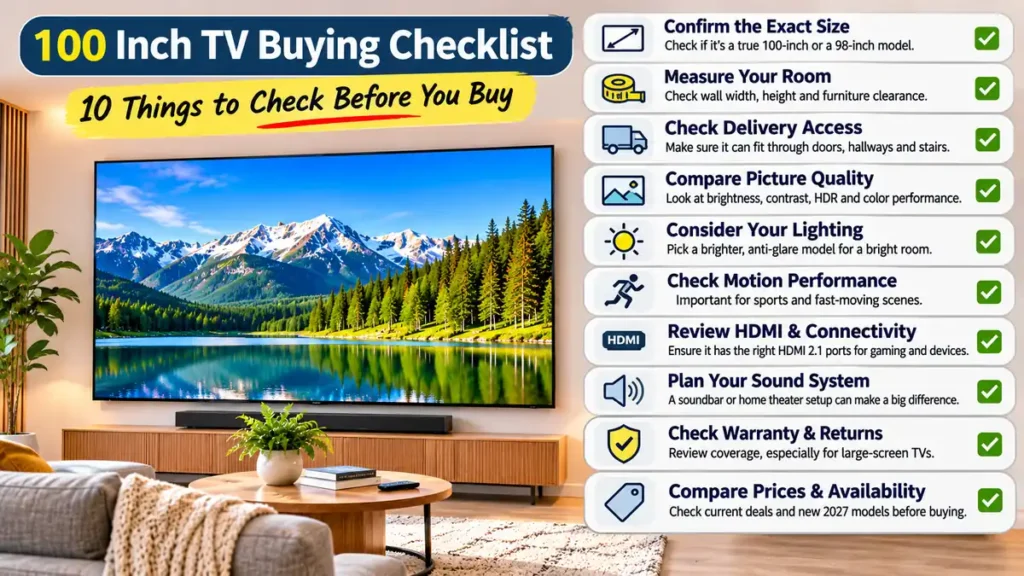
Buying a giant television is a major purchase.
Use this checklist before placing an order.
1. Confirm the Exact Screen Size
A 98-inch television isn’t the same as a 100-inch television.
Check the advertised diagonal and model number.
2. Measure Your Room
Measure wall width, ceiling height, furniture clearance, and seating distance.
Don’t assume that a large wall automatically means a suitable installation space.
3. Check Delivery Access
Confirm that the shipping carton can pass through your entrance, hallways, stairs, and elevator.
4. Compare Picture Quality
Look beyond the manufacturer’s brightness claims.
Review contrast, HDR performance, color accuracy, and processing.
5. Consider Lighting Conditions
Bright rooms require good brightness and reflection handling.
Darker rooms benefit from strong contrast and careful local dimming.
6. Evaluate Motion Performance
For sports and gaming, check independent measurements of pixel response and screen uniformity.
7. Check HDMI Connections
Count how many consoles, streaming devices, and audio systems you need to connect.
Make sure the intended ports support the required features.
8. Plan Your Sound System
Built-in TV speakers may not provide the sound experience expected from a theater-sized picture.
Consider a compatible soundbar or surround-sound system.
9. Review Warranty and Returns
A very large television can be difficult to return.
Read the seller’s damaged-delivery procedures and the manufacturer’s warranty.
10. Verify Current Availability
As 2027 models enter the US market, older televisions may become discounted or disappear from stock.
Compare exact-model prices from reputable retailers before purchasing.
Following these steps will help you choose the best 100 inch TV without focusing solely on size or marketing claims.
Common Mistakes When Buying a Giant TV
The excitement of owning a wall-sized screen can make it easy to overlook practical details.
Mistake 1: Ignoring the difference between 98 and 100 inches.
Always check the exact product dimensions.
Mistake 2: Forgetting delivery clearance.
A television may fit your wall but not the staircase leading to the room.
Mistake 3: Assuming higher brightness guarantees better picture quality.
Contrast, accuracy, and local dimming are also important.
Mistake 4: Using smaller-model reviews as definitive evidence.
Some large TVs use different panels, screen finishes, or backlight systems.
Mistake 5: Ignoring motion handling.
A television with impressive gaming specifications can still show distracting blur.
Mistake 6: Spending everything on the screen.
Budget for installation and audio.
Mistake 7: Buying an enormous TV for a very small room.
Consider your preferred viewing distance and room layout.
Mistake 8: Assuming all models have the same warranty or return policy.
Retailer policies differ, particularly for oversized deliveries.
Frequently Asked Questions
What is the best 100 inch TV in 2027?
Based on independent reviews available through November 2026, the TCL X11L is a strong premium 98-inch alternative, while the TCL QM8K offers excellent overall value. For a true 100-inch television, the Hisense U8QG is worth considering. New 2027 products may change these recommendations.
What is the best budget 100 inch TV?
The 98-inch TCL QM6K is a sensible budget-oriented option. It offers 4K resolution, Mini LED local dimming, and modern gaming features.
Is a 98 inch TV almost the same as 100 inches?
Yes. The diagonal difference is two inches, and a 100-inch 16:9 screen has approximately 4% more display area. Picture quality is often more important than this small size difference.
What are the dimensions of a 100 inch TV?
A 100-inch 16:9 screen measures approximately 87.2 inches wide and 49 inches tall. Actual dimensions depend on the television’s bezel, chassis, and stand.
How far should you sit from a 100 inch TV?
Approximately 9–14 feet is a useful starting range for many households, depending on viewing preferences. Some people prefer a closer cinematic experience.
Which Hisense 100 inch TV is best?
The Hisense 100U8QG is a strong premium choice because of its brightness, contrast, and features. The newer Hisense 100U7SG is another option, although exact-size performance and pricing should be reviewed.
Is TCL a good brand for 100 inch TVs?
TCL offers several competitive 98-inch televisions. The X11L, QM8K, and QM6K cover premium, mid-range, and more affordable categories.
Is a 100 inch TV better than a projector?
A giant TV is often more convenient and brighter for everyday viewing. A projector can be more flexible for larger screens and dedicated dark home theaters.
Can a 100 inch TV be wall mounted?
Many models can be wall mounted with compatible hardware, but installation requirements vary. Check the exact TV’s weight, VESA pattern, structural support requirements, and mounting instructions.
Is 4K enough for a 100 inch TV?
For most homes, yes. A good 4K television can provide an impressive picture at this size, although source quality and processing become especially important.
What is the best 100 inch TV for gaming?
The TCL X11L and QM8K are strong candidates. The Hisense U8QG also offers advanced gaming features, but its motion handling has some limitations.
Are 100 inch TVs expensive to install?
They can be. Installation costs depend on weight, wall construction, mounting equipment, room access, and whether additional electrical or cable work is required.
Final Verdict: Which Giant-Screen TV Should You Buy?
The best 100 inch TV is the one that delivers the right combination of picture quality, screen size, practical installation, and value.
For premium buyers, the TCL X11L offers outstanding picture performance in a 98-inch format.
The TCL QM8K is an excellent alternative if you want strong brightness, contrast, and gaming capabilities at a more reasonable price.
If you insist on an exact 100-inch diagonal, consider the Hisense U8QG. Its high brightness and deep contrast make it an attractive home-theater option.
For budget shoppers, the TCL QM6K provides many desirable modern TV features at a lower price tier.
The Sony BRAVIA 5 is worth considering for movies and lower-quality content, while the Samsung QN90F appeals to buyers prioritizing reflection control.
The Hisense U7SG offers another true 100-inch choice from a newer model generation, although exact-size performance and availability should be confirmed.
Before buying, measure the room, inspect the delivery route, verify installation requirements, and compare current prices.
A thoughtfully chosen giant-screen television can provide an impressive home entertainment experience for years. But the picture, the room, and your budget should decide the purchase, not the diagonal measurement alone.
References and Further Reading
- RTINGS: Best 98–100 Inch TVs
- RTINGS: Hisense 100U8QG Review
- RTINGS: Hisense U7SG Review
- RTINGS: TCL QM8K vs QM8L
- Sony: BRAVIA 5 98-Inch Specifications
- Samsung: QN90F 98-Inch Television
- TCL: 98-Inch QM8K Specifications
Editorial Disclosure: ApnarChoice.com has not personally tested the televisions discussed in this article. Recommendations are based on independent testing, official specifications, and published product comparisons. Product prices, availability, firmware, and performance can vary by size and retailer. This guide uses information available through November 16, 2026 and should be updated when additional 2027 models become available.