On This Page
You don’t need to replace every appliance in your home to enjoy a few useful smart-home features. Sometimes, one small device is enough to make an everyday routine more convenient.
That’s where smart plug uses become interesting.
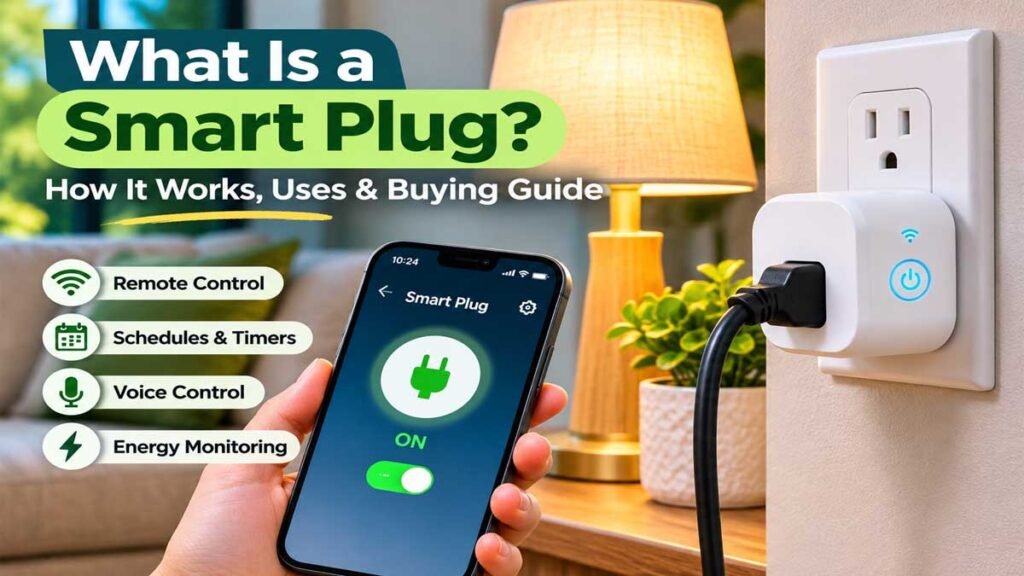
A smart plug connects between a compatible electrical outlet and an appliance, allowing you to control the flow of power through a supported mobile app, schedule, or voice assistant.
You might want your living room lamp to turn on before sunset. Perhaps you forget to switch off your holiday decorations, or you want to understand how much electricity your home office equipment consumes.
These are examples of what a smart plug can help you manage.
However, not every appliance is suitable for smart-plug control. Some devices require manual interaction after power is restored, while others are unsuitable because of electrical loads, heating elements, or safety requirements.
This guide covers 15 practical smart plug uses for everyday living, including lighting, home offices, seasonal decorations, and energy monitoring. You’ll also learn what to check before buying and which appliances should remain outside your smart-plug setup.
What Can You Do With a Smart Plug?
A smart plug is a compact device that allows compatible appliances to receive or stop receiving electricity through electronic controls.
Depending on the model, common features include:
- Remote on/off control through a mobile app
- Scheduled switching
- Countdown timers
- Voice assistant compatibility
- Smart-home routines
- Electricity usage monitoring on selected models
Most basic smart plugs cannot adjust an ordinary appliance’s temperature, speed, brightness, or other internal settings.
They primarily switch the electrical supply on or off.
For example, a conventional table lamp with a physical switch may work well with a compatible smart plug. But a device requiring someone to press a digital start button might not automatically operate when power returns.
Understanding that limitation will help you identify practical smart plug uses instead of purchasing devices that don’t suit your equipment.
New to smart home technology? Read our beginner-friendly guide on what is a smart plug to understand how smart plugs work, their main features, and what to consider before using one.
15 Practical Smart Plug Uses for Your Home
1. Schedule Your Living Room Lamps
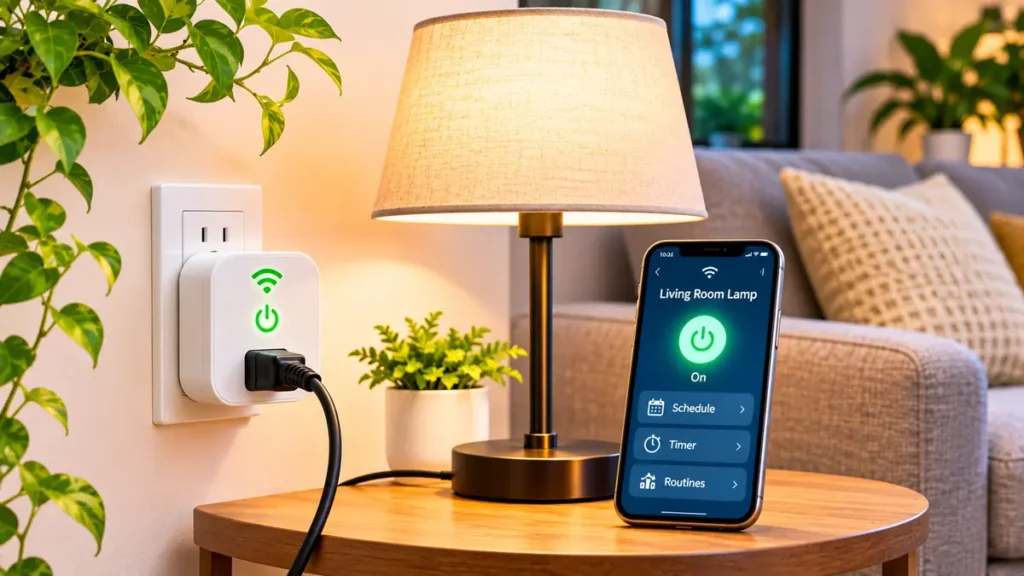
One of the simplest smart plug uses is controlling ordinary table or floor lamps.
Many conventional lamps work with a physical on/off switch. A compatible smart plug can provide scheduled power control without replacing the lamp.
For example, you could create an evening lighting schedule that matches your usual household routine.
This may be helpful when a lamp is positioned behind furniture or when several people use the same room.
Some smart-home platforms also support sunrise and sunset-based schedules.
However, compatibility varies by plug, app, and smart-home platform.
Best for: Conventional lamps with compatible electrical ratings and suitable switches.
2. Automate Bedroom Lighting
Bedroom lighting is another practical use for smart plugs.
A compatible bedside lamp can be included in a bedtime schedule so you don’t have to reach behind furniture for its switch.
Some smart-home platforms also allow several devices to be grouped into a single routine.
This might be useful for switching off selected room lights at a preferred time.
Remember that a smart plug normally provides on/off control, not dimming.
If you want adjustable brightness or color temperature, a compatible smart bulb may be more suitable.
3. Manage Holiday String Lights
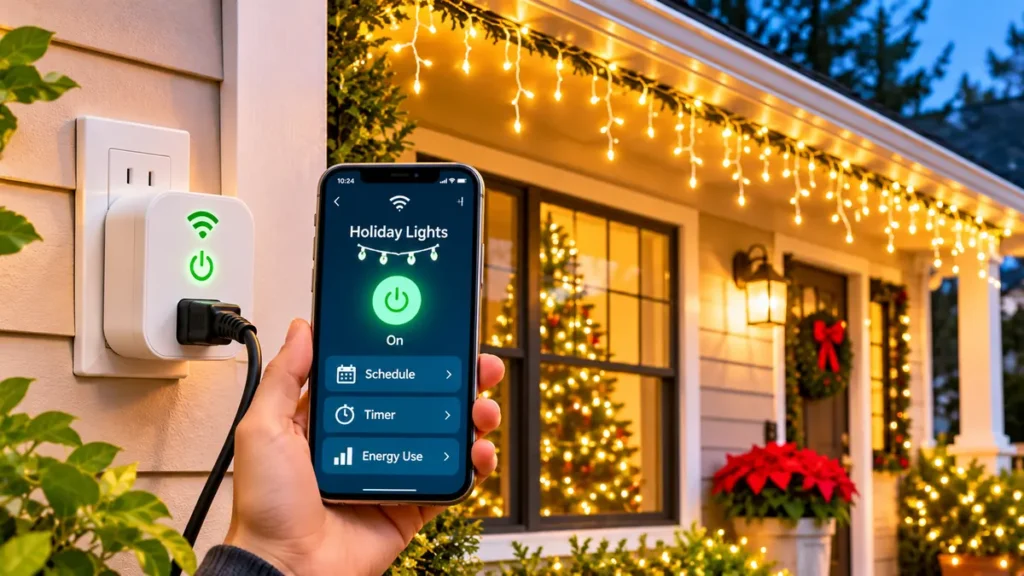
Seasonal decorations often follow a predictable schedule.
Instead of manually switching decorative lights on and off every evening, a suitable smart plug can control their power at selected times.
For example, you might want holiday string lights to operate during the early evening and turn off later at night.
For indoor decorations, choose equipment rated for indoor use.
Outdoor decorations require an outdoor-rated smart plug installed according to the manufacturer’s instructions.
Never assume that an indoor smart plug is suitable for rain, moisture, or outdoor exposure.
Holiday lighting is one of the most convenient smart plug uses because its operating schedule is usually predictable.
4. Control Decorative Accent Lighting
Many homes include decorative lighting behind furniture, around bookshelves, or beside entertainment areas.
Compatible decorative lights may benefit from smart-plug control.
You could include them in an evening routine or switch several decorative lamps off together.
This can be useful in rooms with multiple lighting accessories.
However, some LED lighting systems have their own controllers, dimmers, and memory settings.
Before purchasing a smart plug, check whether the lighting product is designed to resume its previous state when power is restored.
If not, the smart plug may supply power without actually turning the lights on.
5. Make Home Office Lighting More Convenient
A home office often contains a desk lamp, monitor light, charging accessories, and other electronics.
A compatible desk lamp can be useful with scheduled on/off control, especially when your work routine follows consistent hours.
For example, you may prefer an ordinary lamp to switch on at the beginning of your working period.
Keeping lighting controls simple can reduce the number of switches you need to manage.
However, computer monitors and other electronic equipment should not be assumed suitable for repeated power interruption.
Focus on compatible lighting accessories rather than placing every device in your workspace on a smart plug.
Related reading: Our Desk & Workspace guides cover practical ways to organize a comfortable home office.
Looking for more ways to improve your home office? Explore our guide to standing desk accessories for practical lighting, monitor, and workspace organization ideas.
Adding smart lighting to your home office? Our guide to under desk cable management explains practical ways to organize cables and keep your workspace tidy.
6. Set Timers for Compatible Portable Fans
Some simple portable fans can work with smart plugs, provided the appliance and plug manufacturers permit that arrangement.
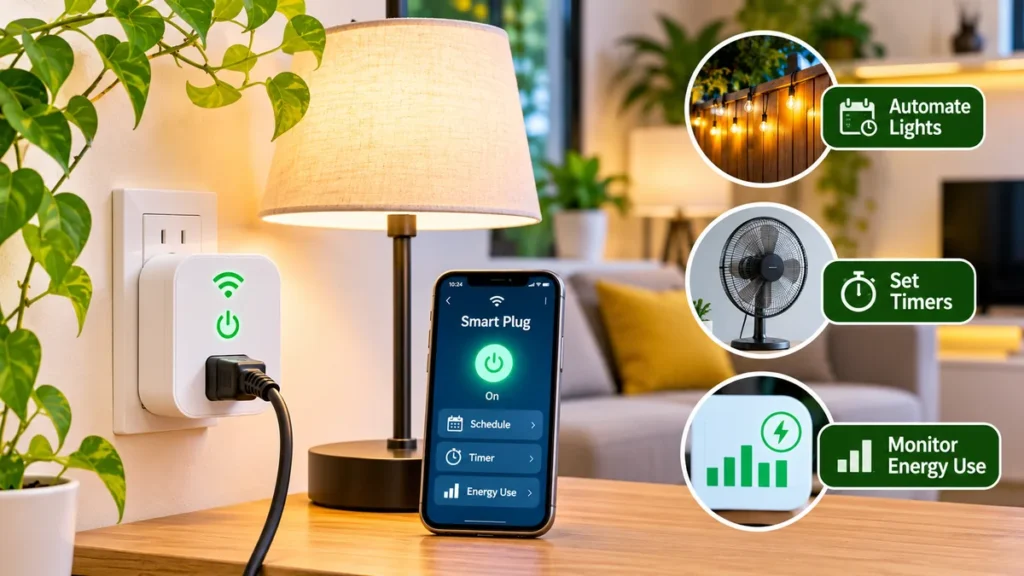
A timer might be useful when you want a fan to turn off after a selected period.
However, many modern fans have electronic controls and may not restart automatically after power is restored.
Others may have manufacturer restrictions concerning remote switching.
Always check both products’ electrical ratings and operating instructions.
Do not use smart-plug automation with equipment that requires continuous supervision or presents a hazard if operated unexpectedly.
7. Control Indoor Plant Grow Lights
Indoor plants sometimes benefit from supplementary lighting, depending on their species and growing conditions.
A compatible LED grow light may be suitable for a regular lighting schedule.
This can help provide a consistent daily routine without requiring someone to operate the light manually.
For example, a grow light can be scheduled around a plant’s recommended light period.
But the correct duration depends on the plant, the light’s intensity, and environmental conditions.
More hours of light aren’t automatically better.
Choose an appropriately rated smart plug and check the grow light manufacturer’s compatibility instructions.
This is among the useful smart plug uses for people who keep houseplants in rooms with limited natural light.
8. Organize Aquarium Lighting
Aquarium lighting often needs a consistent daily schedule.
Certain aquarium light fixtures may be compatible with external timed power control.
A suitable smart plug can help maintain a routine for those lights.
However, aquarium equipment has special requirements.
Filters, pumps, heaters, and other life-support systems should not be casually connected to remote-switching devices because interrupting power could affect aquatic animals.
Keep smart-plug use focused on lighting products that the manufacturers specifically approve for this arrangement.
9. Operate Outdoor Decorative Lighting
Outdoor-rated smart plugs can be useful for compatible decorative lighting on patios, balconies, and garden spaces.
They may support scheduled switching or app-based control.
This can be more convenient than manually operating a switch near an exterior outlet.
Check the product’s weather-resistance rating and installation requirements.
The smart plug, outlet, and connected lighting must all be suitable for their intended outdoor environment.
Weather resistance does not mean every product can be exposed to all conditions.
Never substitute an ordinary indoor smart plug for an outdoor-rated model.
10. Create Simple Evening Routines
Some smart-home platforms allow multiple compatible devices to work together.
For example, a routine may switch on selected lamps in the evening and turn them off later.
This is useful when several lights are controlled by separate switches.
The exact features depend on the smart plug and the platform you use.
Some products support only their manufacturer’s app, while others work with compatible ecosystems such as Alexa, Google Home, or Apple Home.
Check interoperability before purchasing.
The goal is to simplify everyday tasks rather than create an unnecessarily complicated system.
11. Manage Lights While Traveling
Certain smart plugs support remote control when connected to a suitable home network and configured through the manufacturer’s supported service.
This may allow you to manage compatible lamps while away from home.
Some products also offer schedules or an away-mode feature.
For example, selected lights might operate according to a schedule even when no one is home.
However, automated lighting is not a replacement for proper home security measures.
It does not guarantee that a home is protected.
Smart plug uses related to travel should be treated as convenience features rather than security guarantees.
12. Monitor Electricity Consumption
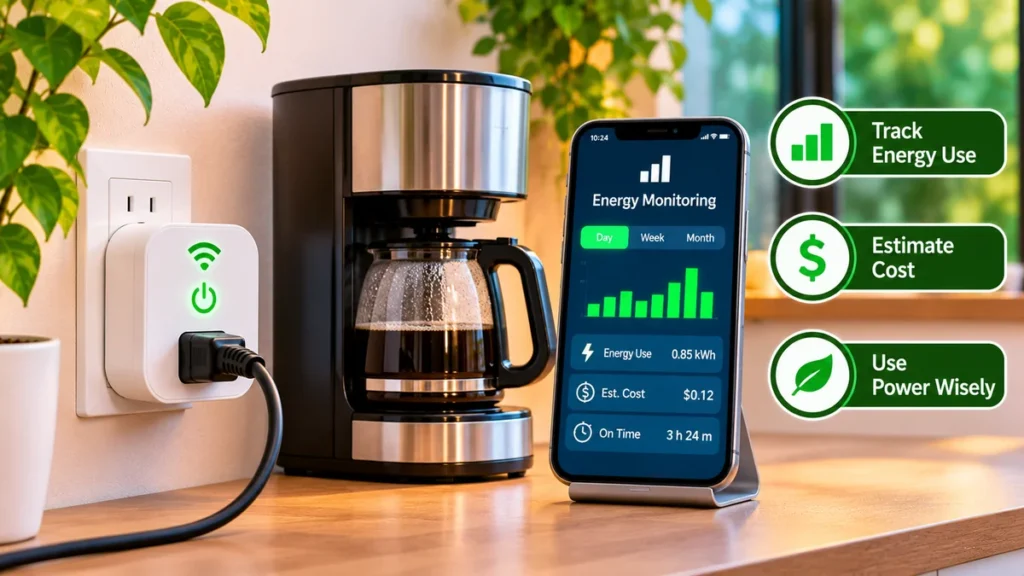
Some smart plugs include built-in energy monitoring.
Depending on the model, you may be able to view a connected device’s electricity consumption in the manufacturer’s app.
This can help you understand the power use of compatible household electronics.
For example, you might compare the electricity consumption of different lamps or observe how much energy a device uses over a period.
Not all smart plugs provide this information.
Some report instantaneous power, while others display energy use over time.
The accuracy and available measurements also vary by product.
Important: A smart plug without energy-monitoring hardware cannot automatically provide detailed electricity consumption data simply because it connects to an app.
13. Reduce Unnecessary Standby Power
Some electronic devices use a small amount of electricity even when they’re not actively performing their main functions.
This is sometimes called standby or vampire power.
A compatible smart plug may allow selected nonessential devices to be disconnected from power during periods when they’re not needed.
However, the potential savings vary considerably.
Modern electronic devices may already have low standby consumption.
Also, some equipment requires continuous power for updates, recording, connectivity, or other essential functions.
Before automating a device’s power supply, review its manufacturer’s guidance.
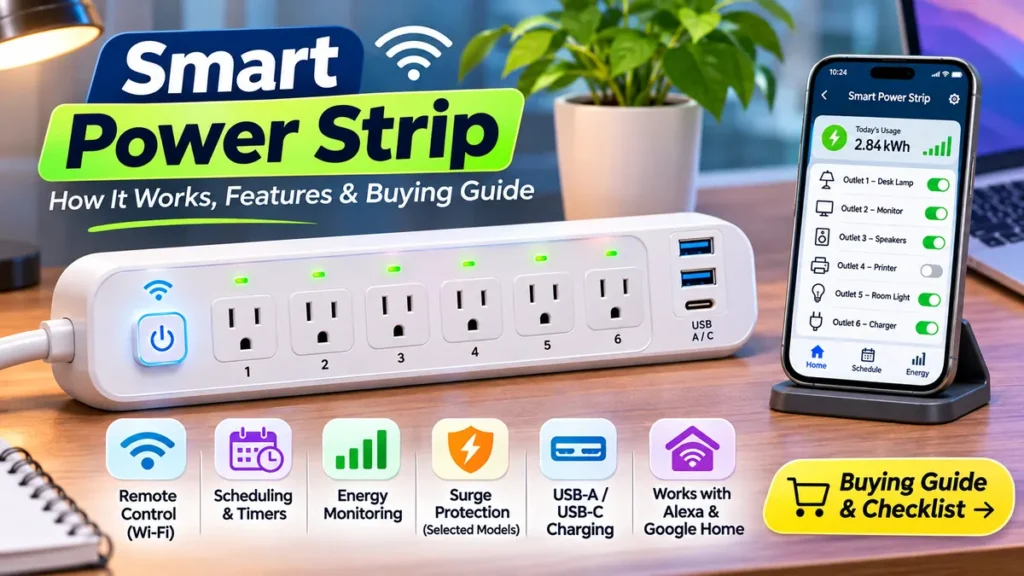
For several electronic devices, a suitable advanced power strip may be a better solution than several individual smart plugs.
Avoid interrupting power to computers or equipment that needs a proper shutdown process.
14. Control Hard-to-Reach Lamps
Sometimes the most useful smart-home improvement solves a small annoyance.
A floor lamp might be positioned behind a sofa, bookshelf, or other furniture.
Reaching its switch every day can be inconvenient.
A suitable smart plug may allow that lamp to be controlled through an app or compatible voice assistant.
Choose an accessible outlet, and avoid placing electrical equipment in locations that prevent inspection or safe disconnection.
This is one of the simplest smart plug uses because it doesn’t require complex automation.
It just makes an existing lamp easier to control.
15. Create a More Organized Smart Home
Smart plugs are most useful when they support a clear household need.
Instead of installing one on every outlet, identify the devices you regularly want to manage.
You might choose a compatible desk lamp, a seasonal lighting setup, and an energy-monitoring plug for selected electronics.
Keeping the number of devices manageable can make your smart-home system easier to maintain.
Give devices recognizable names in the supported app and review unused schedules when your routine changes.
Also keep your smart-home apps and device firmware updated according to manufacturer guidance.
A good smart-home system should make everyday tasks simpler, not require constant troubleshooting.
Smart Plug Uses at a Glance
| Device or Situation | Potential Benefit | Important Consideration |
|---|---|---|
| Living room lamp | Scheduled lighting | Compatible physical switch |
| Bedroom lamp | Bedtime routine | Basic plugs don’t dim |
| Holiday lights | Automatic switching | Indoor/outdoor rating |
| Decorative lights | Group control | Controller compatibility |
| Desk lamp | Work routine | Device electrical rating |
| Compatible fan | Timed operation | Manufacturer approval |
| Grow lights | Consistent light schedule | Plant requirements |
| Aquarium lighting | Scheduled lighting | Avoid life-support equipment |
| Patio lights | Outdoor scheduling | Weather-rated equipment |
| Evening routines | Multiple-device control | Ecosystem support |
| Travel lighting | Remote convenience | Not a security guarantee |
| Energy monitoring | Usage information | Supported models only |
| Standby electronics | Possible energy reduction | Avoid essential equipment |
| Hard-to-reach lamp | Easier switching | Accessible installation |
| Smart-home routines | Everyday convenience | Reliable network and setup |
What Should You Not Plug Into a Smart Plug?
Not every electrical device is suitable for remote power control.
Be particularly cautious with equipment involving high heat, large electrical loads, motors, or essential continuous operation.
Examples that generally should not be controlled through ordinary consumer smart plugs without explicit manufacturer authorization include:
- Space heaters and portable heating appliances
- Irons, toasters, kettles, and similar heating equipment
- Refrigerators and freezers
- Medical or other essential equipment
- Appliances requiring continuous supervision
- Devices that may create hazards when restarted unexpectedly
- Equipment exceeding the plug’s electrical rating
Do not connect smart plugs in a way that bypasses the manufacturer’s safety instructions.
Avoid connecting one smart plug or power strip through another in an unsupported arrangement.
A smart plug is not a substitute for safe electrical wiring, appropriate protection, or supervised use of appliances.
When in doubt, leave the appliance connected according to its original instructions and consult the manufacturer or a qualified electrician.
How to Choose a Smart Plug
Understanding smart plug uses is helpful, but choosing the right product matters just as much.
Check Electrical Compatibility
Choose a smart plug with ratings suitable for your electrical system and intended appliance.
In the United States, standard household outlets commonly supply 120-volt power, but the suitability of a smart plug depends on the particular circuit, device, and product specifications.
Never exceed the manufacturer’s stated ratings.
Choose the Right Smart-Home Ecosystem
Check whether the product works with the smart-home platform you already use.
Popular ecosystems include Amazon Alexa, Google Home, and Apple Home.
Some products support Matter, an interoperability standard designed to help compatible smart-home devices work across different platforms.
Compatibility labels should always be checked for the specific model.
Decide Whether You Need Energy Monitoring
If you’re interested in measuring electricity use, choose a model that explicitly supports energy monitoring.
Basic on/off smart plugs may cost less, but they won’t necessarily provide consumption statistics.
Consider Outlet Size
Some smart plugs are bulky enough to obstruct the second receptacle on a wall outlet.
Compact models may be more convenient in small spaces.
Check the product’s dimensions before buying.
Check Indoor or Outdoor Suitability
Outdoor-rated smart plugs are specifically designed for appropriate exterior applications.
Indoor-only products should remain indoors.
Always follow the manufacturer’s placement and weather-exposure instructions.
Smart Plug vs Smart Bulb: Which Is Better?
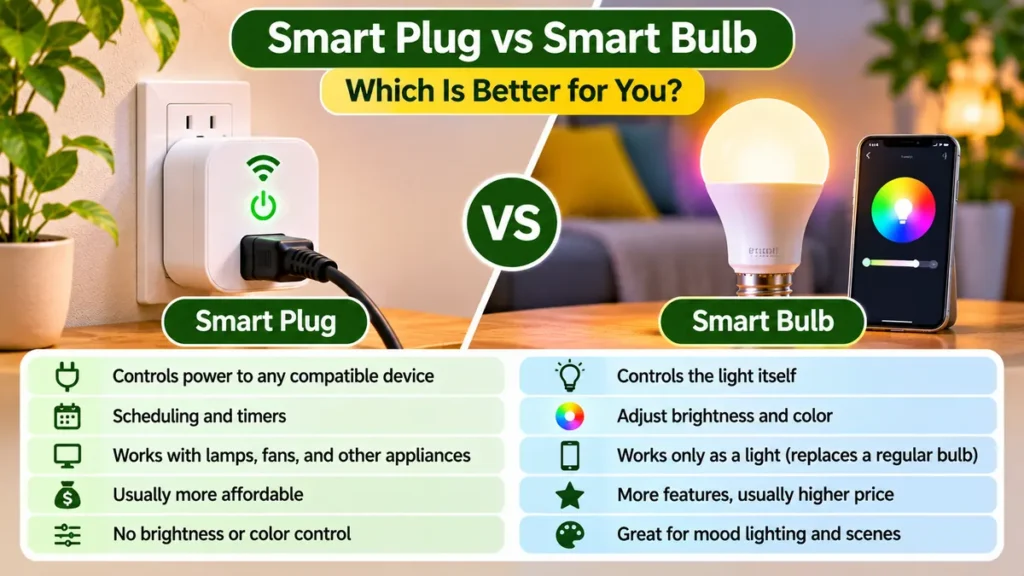
Both devices can help automate home lighting, but they provide different functions.
| Feature | Smart Plug | Smart Bulb |
|---|---|---|
| Main purpose | Controls electrical power | Controls the light itself |
| App on/off control | Usually | Usually |
| Scheduling | Often | Often |
| Dimming | Usually not | Often |
| Color adjustment | No | Selected models |
| Works with ordinary bulbs | Through compatible lamp | Replaces existing bulb |
| Controls non-lighting devices | Selected compatible appliances | No |
A smart plug may be more practical when you want basic control over an ordinary lamp.
A smart bulb is usually more appropriate when you want brightness adjustment, color selection, or advanced lighting scenes.
If you’re only interested in simple on/off automation, replacing every bulb may be unnecessary.
Do Smart Plugs Save Electricity?
Smart plugs don’t automatically reduce electricity consumption simply because they’re connected.
They can help manage when certain compatible devices receive power.
Some energy-monitoring models also provide information that can support better decisions.
Whether this reduces your electricity bill depends on the connected device, its standby consumption, your operating schedule, and the smart plug’s own energy use.
For example, switching off a device that consumes very little standby electricity may produce only a small saving.
Using a smart plug to control an unnecessary lighting schedule could reduce energy consumption if it genuinely shortens the operating time.
Avoid assuming that smart plugs guarantee a particular percentage of energy savings.
Actual results depend on household habits and equipment.
Common Smart Plug Mistakes to Avoid
Buying Without Checking Compatibility
Some appliances require a manual start button even when electricity is available.
A smart plug may not be able to operate them as expected.
Ignoring Electrical Ratings
Connecting unsuitable appliances can create hazards.
Always follow the ratings and instructions of both products.
Using Indoor Plugs Outdoors
Outdoor conditions require appropriately rated equipment.
Assuming Every Smart Plug Monitors Energy
Energy monitoring is a separate feature.
Check the specifications before buying.
Creating Too Many Automations
Multiple overlapping schedules can make it difficult to understand why a device is switching on or off.
Keep routines straightforward.
Depending on Smart Plugs for Essential Devices
Avoid using ordinary smart plugs to control equipment that must remain powered for health, safety, or other critical functions.
Forgetting Network Reliability
Some smart features depend on a reliable network, cloud service, or compatible hub.
Check which functions remain available when internet connectivity is interrupted.
Frequently Asked Questions
What are the best smart plug uses?
Some of the most practical smart plug uses include scheduling compatible lamps, controlling holiday lights, managing decorative lighting, and monitoring electricity use with supported models.
Can I use a smart plug with any appliance?
No. The appliance must be electrically compatible, permitted by its manufacturer for the intended use, and safe to control through an external power switch.
Do smart plugs work without Wi-Fi?
It depends on the model and communication technology. Some devices rely on Wi-Fi, while others use supported local wireless networks or hubs. Certain schedules may continue without internet access.
Can smart plugs turn lights on automatically?
Yes. Many models support schedules, timers, or compatible smart-home routines for suitable lamps and lighting accessories.
Are smart plugs good for renters?
They can be convenient because many models don’t require permanent modifications to the home. However, electrical compatibility and the rental property’s rules still matter.
Can smart plugs reduce electricity bills?
Possibly. Savings depend on the connected equipment and how its operating time changes. Smart plugs don’t guarantee lower bills.
Can I use a smart plug with Alexa or Google Home?
Many models support these platforms, but compatibility varies. Check the exact product’s specifications.
Do smart plugs work with Apple Home?
Some do. Look for confirmed Apple Home compatibility or supported Matter functionality, depending on your setup.
Can I use a smart plug outside?
Only use a model specifically rated and approved for the intended outdoor environment.
Are smart plugs safe to leave connected?
A properly rated, appropriately installed smart plug may be designed for ongoing connection, but users must follow the manufacturer’s electrical, environmental, and operating instructions. Never use one with damaged equipment or an unsuitable appliance.
Final Thoughts
The best smart plug uses solve everyday problems without introducing unnecessary complexity.
You might start with one compatible lamp, a seasonal lighting schedule, or an energy-monitoring device.
From there, you can decide whether additional automation would genuinely improve your home.
Always consider the appliance’s electrical requirements, the smart plug’s capabilities, and the manufacturer’s safety instructions.
A thoughtfully chosen smart plug can be a convenient addition to a modern home.
And sometimes, the simplest setup is the most useful.